Costs
Part of The honest guide to SEO strategy, 2027 edition
Confirming SEO strategy readiness: a checklist from audience to governance
A strategy review scores each checklist item pass, fail, unknown or not applicable, then attaches supporting evidence, an owner and a next action.
What to take away
- Score every item pass, fail, unknown or not applicable, and attach evidence, affected URLs, an owner and a next action.
- A tool result is a lead to investigate, not a completed correction or an index guarantee.
- Fix blockers and misleading pages on destinations that already earn before approving new production volume.
- Record what a test did not confirm, so nobody reads a green result as a promise.
- Recheck after release and against business outcomes, not against the checklist itself.
An SEO strategy review ends in decisions, owners and tests. Score each item pass, fail, unknown or not applicable. Attach evidence, affected URLs, business impact, next action and review date. Do not hide uncertainty behind one health score.
Business, audience and demand
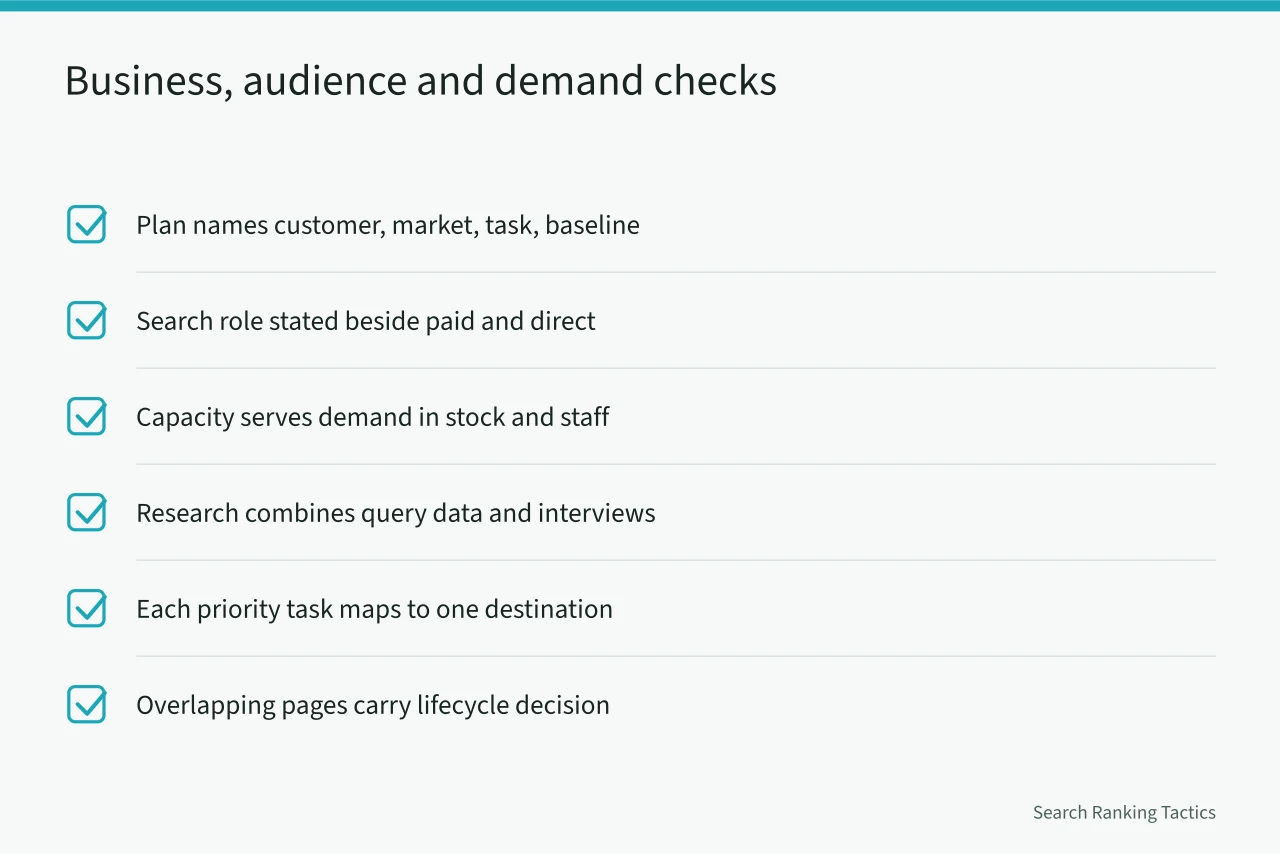
- The plan names the customer, the market, the task, the next action, the baseline, the value, the time horizon and what it excludes.
- Search has a stated role beside paid, direct, partner, product, sales and service channels.
- Capacity can serve the demand the plan aims to create, in stock, staff and support hours.
- Research combines query data with site search, sales calls, service tickets, reviews and customer interviews.
- Each priority task maps to one destination: a product, service, category, location, guide, tool or support page.
- Overlapping, obsolete and unsupported pages each carry a documented lifecycle decision.
Technical eligibility
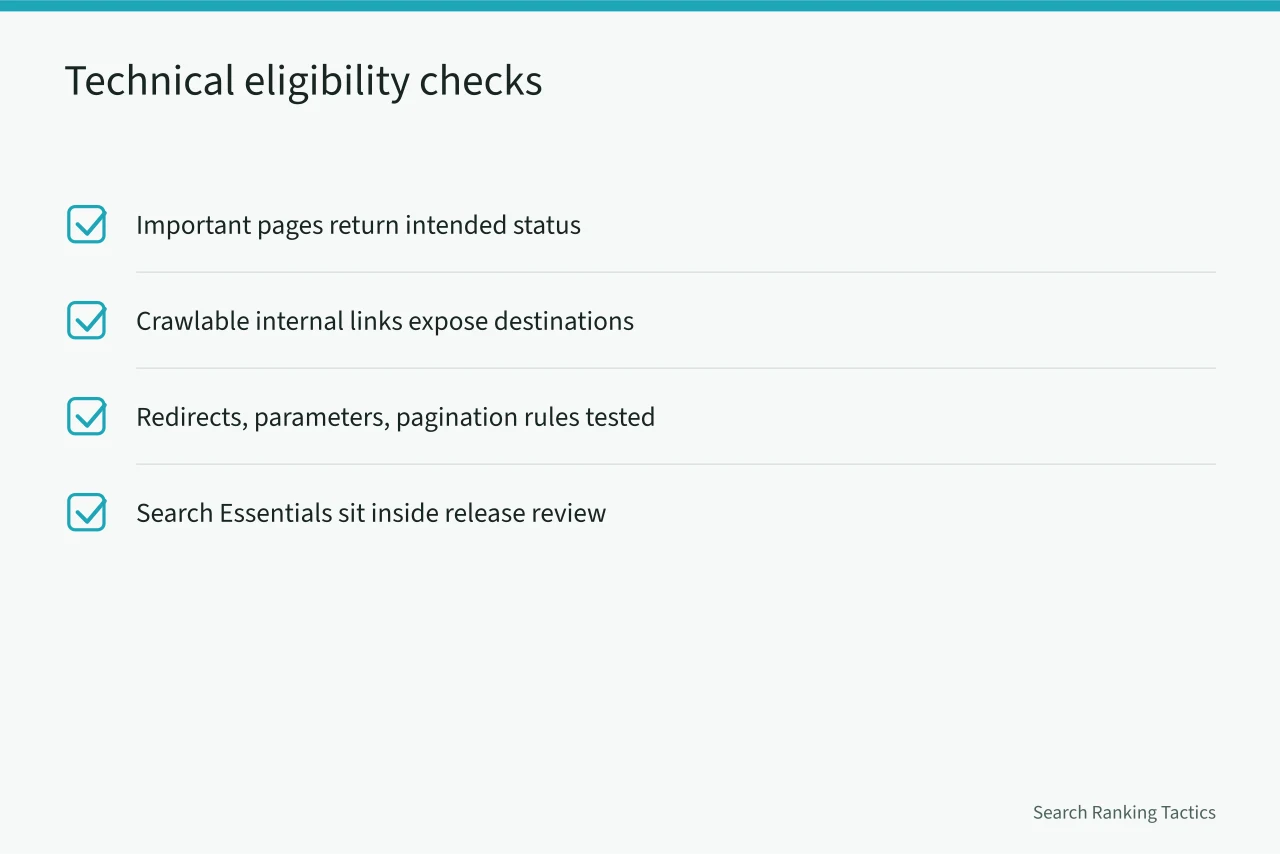
- Important pages return the intended status, can be crawled and rendered, and carry consistent robots and canonical signals.
- Crawlable internal links expose important destinations; a sitemap alone does not.
- Redirects, parameters, pagination, faceting, language versions and templates have tested rules.
- Google Search Essentials and applicable search-engine policies sit inside release review.
Content and experience
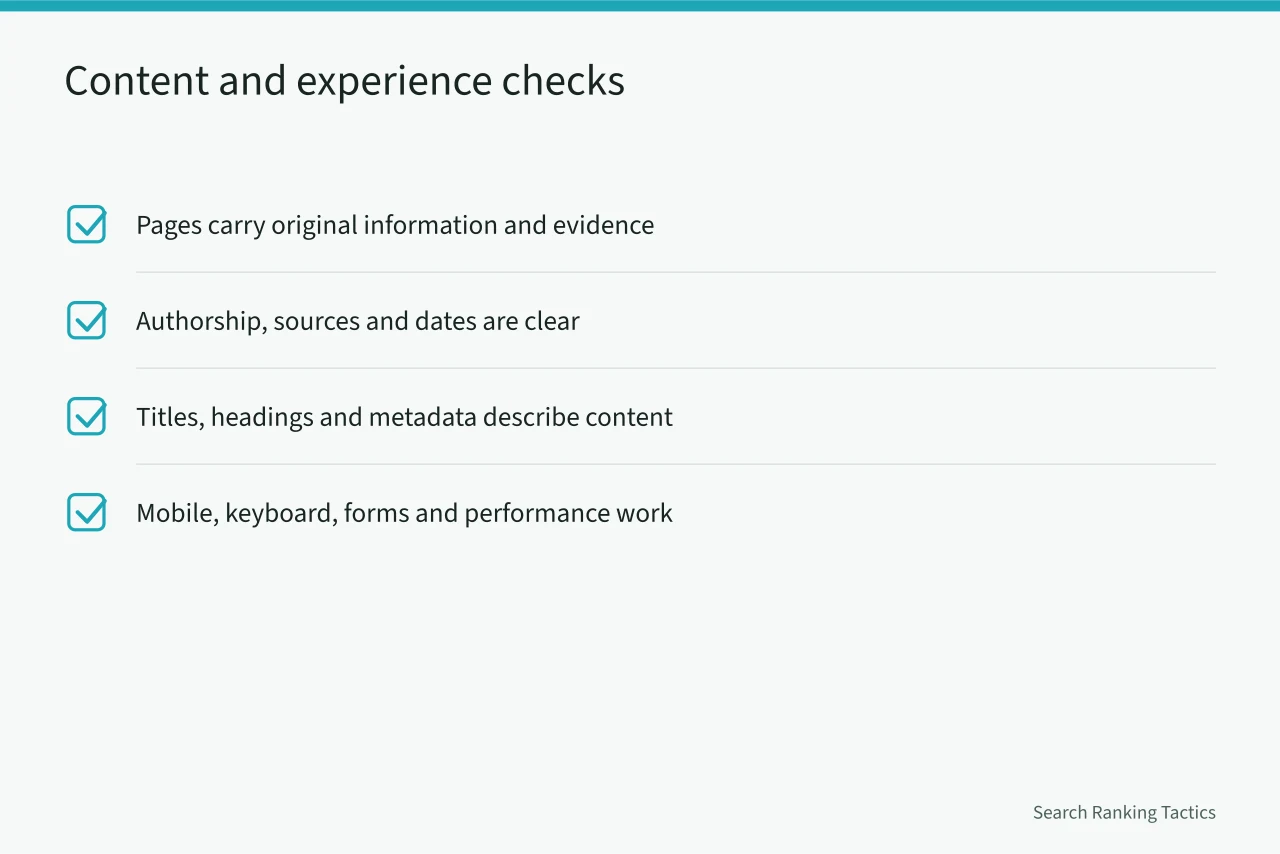
- Pages carry original information, experience, method, examples or evidence suited to the task.
- Authorship, review, sources, commercial relationships, dates, corrections and limitations are clear where readers expect them.
- Titles, headings, links, images, video, structured data and metadata describe visible content accurately.
- Mobile use, keyboard access, forms, security, performance, consent and support paths work on representative templates.
Measurement and governance
- Search Console definitions, filters, properties, dates and known gaps are written down.
- Visibility and visits connect to qualified outcomes, contribution, retention or mission value.
- The backlog names evidence, owner, dependency, acceptance test, release, guardrail and review date.
- Migrations carry URL maps, baselines, monitoring, communication and rollback conditions.
- AI-search citations are diagnostics, not proof of ranking, authority or business impact.
Prioritize failures that block valuable existing destinations, mislead customers or create template-wide risk. Recheck live releases and business outcomes. The review is finished when the team can explain what changed and what evidence decides the next step.
Confirm basic search eligibility
Google's website inclusion checklist covers whether a site appears, whether content is accessible, whether the information is useful, and whether local or image contexts apply. Use it as a first screen, then test representative templates and live URLs. Passing it does not guarantee indexing or visibility.
Inspect representative live URLs
Search Console URL Inspection documentation separates indexed information from a live test, and lists conditions the live test does not check. Record the version examined, crawl time, canonical information and rendered page. Record resources and limits before marking the item complete.
A positive live result is not an index guarantee. It still leaves open the SEO strategy questions about indexing, so write down what the test did not confirm.
Decision table
| Checklist state | Required note | Next action |
|---|---|---|
| Pass | Evidence, URL sample, date, owner | Monitor at the stated cadence |
| Fail | Impact, scope, cause, dependency | Prioritize and define acceptance |
| Unknown | Missing access, data or decision | Assign investigation and deadline |
| Not applicable | Reason and approving owner | Revisit if scope changes |
| Released | Production verification and outcome window | Confirm result or correct |
Record the gate result
The W3C Privacy Principles statement gives web-system designers shared privacy concepts and warns against shifting privacy work onto individuals. Apply that to the review, then check the governing law and configuration. The same shift affects SEO analytics, where consent and configuration decide which search data is usable.
The CISA software acquisition fact sheet covers development practice, supply-chain exposure, deployment and vulnerability management. Add those acquisition questions to the review, without treating them as local approval.
Common questions
How should a checklist item be scored?
Use pass, fail, unknown or not applicable. Include attached evidence, affected URLs, owner, decision and review date. A decorative percentage tells the next reader nothing.
Does a valid URL Inspection result guarantee indexing?
No. The live test checks selected access and processing conditions, and explicitly omits several quality, duplication, legal and security conditions.
What should be fixed first?
Start with issues that block, misdirect or mislead valuable existing customer destinations, or that create template, security, legal or migration risk.