Strategy
Part of The honest guide to SEO strategy, 2027 edition
Setting SEO strategy benchmarks: baselines, page groups, and thresholds
SEO strategy benchmarks in 2027 need a clean baseline, page groups, technical states, demand context, qualified outcomes, uncertainty, and decision thresholds.
What to take away
- Build the benchmark from the site's own dated baseline and comparable page groups before using an outside reference point.
- Preserve every metric's definition, source, property, filters, period, market, device, maturity, and known data gap.
- Set investigation, success, and harm thresholds tied to a decision instead of promising one universal industry number.
SEO strategy benchmarks should describe a site's own starting condition and decision thresholds before they imitate an industry average. Search demand, brand recognition, market, device mix, page role, seasonality, site history, and measurement vary too much for one responsible traffic, ranking, or conversion promise.
Benchmark the measurement setup
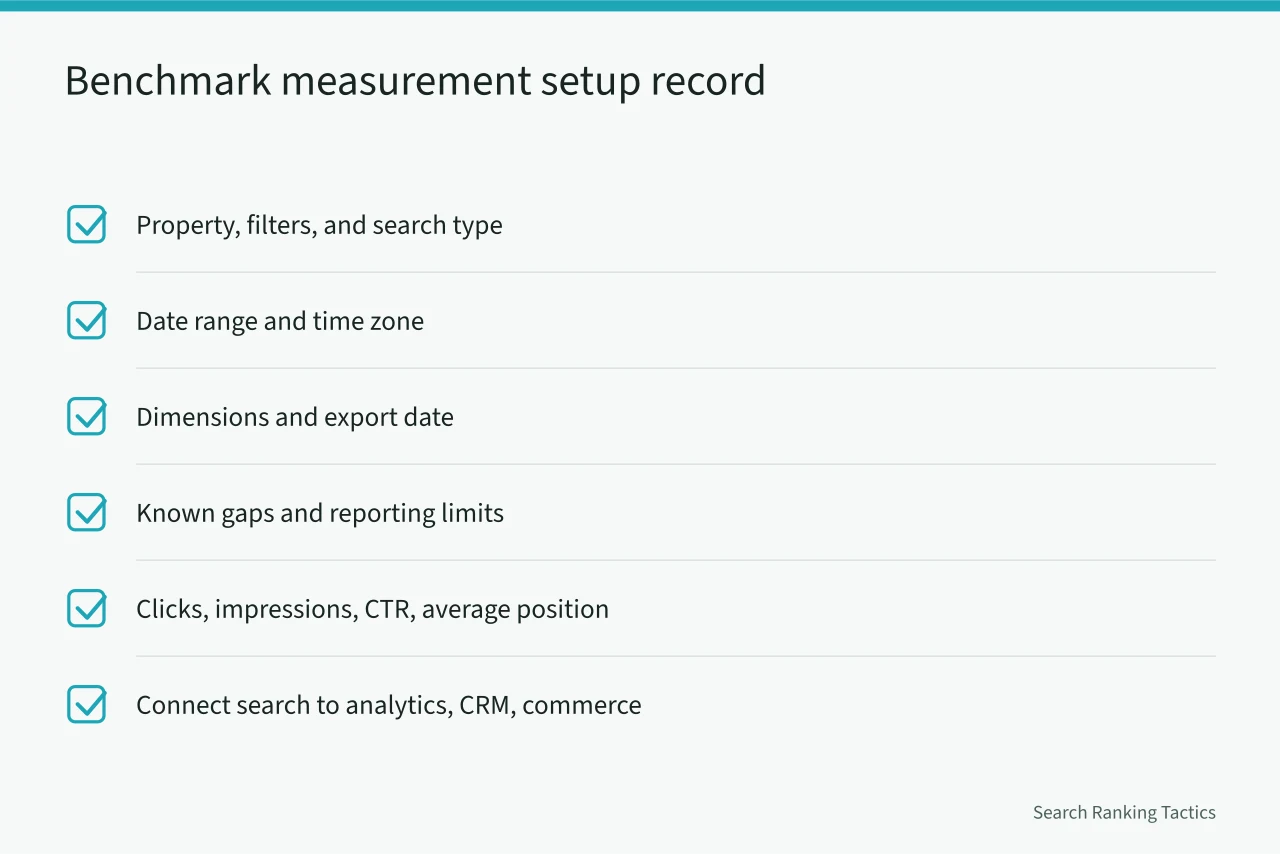
Record the property, filters, search type, date range, time zone, dimensions, export date, and known gaps. Google's Search Console Performance report documentation defines clicks, impressions, click-through rate, average position, dimensions, filters, and reporting limits. Preserve those definitions and connect search measures with analytics, CRM, commerce, service, or finance evidence before setting a business threshold.
Create comparable page groups
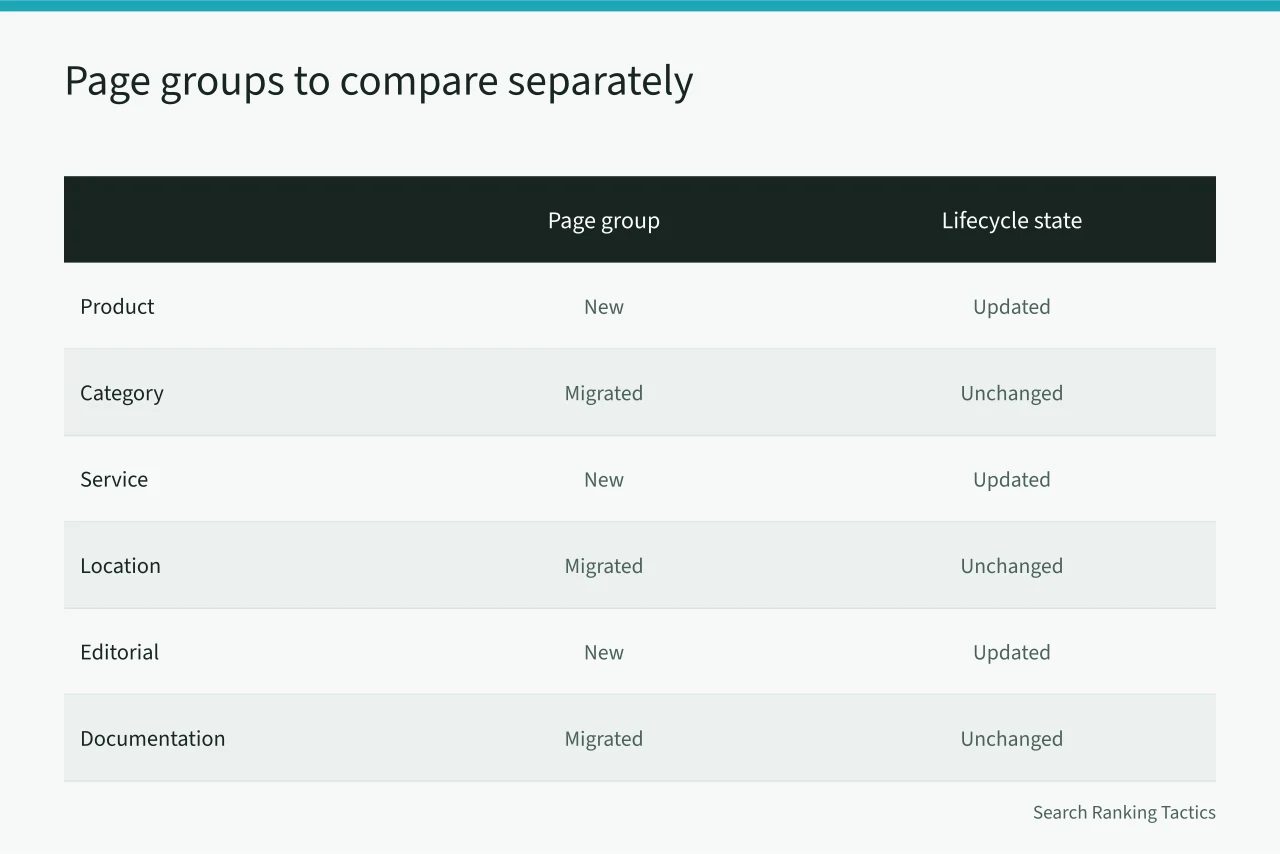
Group product, category, service, location, editorial, documentation, video, and support pages separately. Split new, updated, migrated, and unchanged destinations. Compare like markets and maturity windows. A sitewide average can hide a successful product section and a failing template.
Measure technical readiness
Track access, rendering, canonical alignment, navigation, and indexing separately from experience. Search Console's Core Web Vitals report documentation says its page performance groups use real-world CrUX data and explains coverage and grouping limits. Treat that report as one field-data diagnostic, not a complete technical-readiness score, ranking guarantee, or substitute for direct user testing.
Measure discovery and response
Track impressions, clicks, click-through rate, query coverage, landing pages, and citations where supported. Average position is contextual and not an outcome. Segment branded and non-branded groups carefully, preserve changing interfaces, and connect visibility to the next customer and business step.
Connect to qualified outcomes
Measure valid inquiries, sales acceptance, bookings, orders, applications, subscription, contribution, retention, support resolution, or another mission outcome. Track value per landing-page group and time to maturity. State unmatched, offline, delayed, duplicated, refunded, and canceled outcomes.
Set thresholds, not promises
Define ranges for expected noise, investigation, success, and harm using historical variation, demand context, controlled comparisons, release scope, and business capacity. Search guidance creates no universal benchmark for a page or company. Record assumptions and the decision that follows each threshold. Thresholds only make sense once you know which SEO strategy mistakes they are meant to catch.
Use a benchmark record
- Metric, definition, source, filters, owner, and extraction date.
- Page group, market, device, period, demand context, and maturity.
- Baseline range, target range, guardrail, confidence, and review date.
- Decision that follows when the value is above, within, or below range.
Decision table
| Benchmark field | Record | Why it matters |
|---|---|---|
| Population | Eligible URL or customer group | The denominator remains visible |
| Context | Market, device, demand, role, and maturity | Unlike pages are not blended |
| Measure | Definition, source, filters, and period | A number remains reproducible |
| Range | Noise, investigation, success, and harm | Normal variation is not overread |
| Decision | Owner, action, and review date | The benchmark changes work |
Make the comparison reproducible
The GAO evaluation design guide connects evaluation questions with evidence needs and design choices. Apply that discipline to SEO strategy benchmarks; federal evaluation guidance does not make a local marketing result causal or transferable. Evaluation questions also shape the SEO strategy checklist items you track before any benchmark is set.
The NIST experimental design selection guidance begins design choice with the objective and practical constraints. It supports separating SEO strategy benchmarks reporting from controlled effect estimates, not turning observation into causation.
Common questions
What is a good SEO benchmark?
It is a reproducible baseline or comparison matched to the same page role, market, demand context, maturity, definition, source, filters, and decision.
Should a company use industry click-through rates?
Only as a limited reference. Search appearance, query mix, position, brand, device, market, and method can make an outside average unsuitable.
How should benchmark uncertainty be reported?
State data gaps, normal variation, sampling or aggregation, attribution limits, concurrent changes, scenario ranges, and the threshold that would change the decision.