Operations
Part of Keyword research, minus the hype in 2027
Keyword research questions, sorted out, 2027 edition
Common keyword research questions in 2027 cover search volume, intent, page scope, low-volume tasks, competitor data, source limits, and meaningful outcome measures.
What to take away
- A recorded query is an observation from a defined source; a planned keyword is a research label for a customer task.
- No tool provides a universal exact volume, and no fixed keyword count determines how many phrases belong on one page.
- Measure the connected path from intended task and useful destination to search diagnostics, qualified actions, and business value.
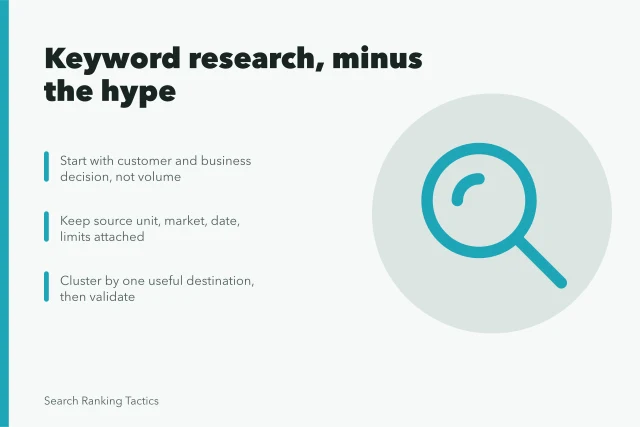
Common keyword research questions often treat every metric as exact. In practice, tools observe or estimate different populations. Keep the source, country, dates, settings, method, and decision beside every value. The aim is a useful destination map, not the largest phrase list.
What is a keyword?
A keyword is a word or phrase used to describe or search for a task, entity, problem, product, or action. A recorded query is an actual expression in a specific data source; a planned keyword is a research label. Do not confuse the two.
Is search volume exact?
No. No single tool provides a universal exact count, and tools disagree because they sample different populations with different settings.
Google's FAQ about Trends data explains that Trends uses a sampled, normalized dataset and is not a scientific poll. Preserve the comparison, geography, period, category, and search surface, and use the result as relative evidence rather than an absolute market total.
Google Keyword Planner returns rounded ranges, adjusted by account, location, network, and bid settings. Google Search Console reports impressions, clicks, and position for queries where your site already appears, and it gives no volume estimate. Third-party estimators publish their own models, and two of them rarely agree on one phrase.
Exact vs Relative Volume
Exact count
- Source
- Universal tool
- Method
- Absolute total
- Context
- Not needed
- Use
- Market total
Relative evidence
- Source
- Sampled dataset
- Method
- Normalized sample
- Context
- Geography, period, category
- Use
- Comparison only
What does search intent mean?
Intent is the likely task behind a query in context. Inspect language, current results, customer research, device, location, and the business offer. Labels such as informational or transactional summarize patterns, but they do not define the exact evidence or page a person needs.
How many keywords belong on one page?
No fixed number. Group phrases when one page solves the same coherent task naturally. Split when product, location, audience, format, or required evidence differs. Split also when the next action differs.
Typical practice: one service page covers a handful of closely related phrases, often fewer than 20. A category page can cover dozens. Treat both as working ranges, not targets.
Worked example. Suppose a plumbing company serves one city. Three phrases share one page: emergency plumber, burst pipe repair, and plumber open now, each combined with the city name. Same task, same evidence, same next action.
Water heater installation splits off into its own page. The task, the evidence, the quote process, and the next action differ.
Descriptive language belongs in prominent page elements. Mechanical repetition does not improve answers. On ecommerce sites, faceted navigation creates thousands of crawlable URLs, making grouping and splitting decisions harder.
Are low-volume phrases worth targeting?
They can be valuable when they signal precise fit, urgency, a high-value product, or recurring support demand. Low-volume tools can also be noisy or suppress data. Validate with customer conversations, sales, service, site search, and paid tests where appropriate.
Should we copy competitor keywords?
Use competitor visibility to discover tasks and content models, not to copy a list. A competitor may serve another segment, market, price, or product. Confirm customer relevance, evidence, capacity, and the destination your business can genuinely provide.
How do we measure success?
Track whether the mapped page becomes eligible, appears for the intended task group, earns useful visits, and produces qualified outcomes.
Name the metric. In Google Search Console, impressions, clicks, and average position for the mapped query group are diagnostics. A booked estimate, a completed application, or a first invoice is an outcome.
Record each diagnostic with its property, filters, dimensions, period, and limits, then connect it to leads, orders, applications, support resolution, and contribution. Otherwise, use another mission measure.
B2B teams: qualified outcomes are sales accepted leads and pipeline created, not organic sessions.
What do advertising forecasts mean?
Google Ads says Keyword Planner forecasts use factors such as bid, budget, seasonality, and historical ad quality to estimate possible advertising performance, and refresh as market conditions change. They are planning scenarios for paid campaigns, not guarantees of organic traffic, revenue, or future demand.
Decision table
| Question | Working answer | Required context |
|---|---|---|
| Is volume exact? | Use the number to rank opportunities, not to size a market | Tool, unit, market, network, filters, limits |
| How many phrases per page? | Enough to answer one whole task, with no fixed target | Audience, format, seasonality, next action |
| Are small tasks useful? | Treat a narrow phrase as a lead, not a traffic source | Fit, urgency, margin, repeat demand |
| What proves success? | A search diagnostic that tracks a qualified outcome | Property, filters, period, review date |
Keep a decision record
Write one short record per question: the evidence used, the source and its settings, the answer chosen, and the date to revisit it. That record stops the same debate from restarting next quarter.
The GAO evaluation design guide connects evaluation questions with evidence needs and design choices. The same discipline applies to common keyword research questions, though outside guidance does not make a local marketing result causal.
The W3C Privacy Principles statement gives web-system designers shared privacy concepts and warns against shifting privacy work to individuals.
Common questions
What is the difference between a query and a keyword?
A query is observed in a data source. A keyword is a label in a plan. One can be measured; the other is a decision.
Should low-volume keywords be ignored?
No. Judge a narrow phrase by the revenue or the support cost behind it, not by a tool's bar chart.
Can competitor keywords be copied?
They can reveal questions, not answers. Your segment, market, authority, and margins differ from theirs.