Strategy
Keyword research for B2B SaaS in the US: intent clusters that survive 2027
Map US B2B SaaS buyer questions into four intent clusters tied to pipeline stages, then set scope, sourcing, and tooling for keyword research in 2027.
What to take away
- Build clusters around the buyer's job and pipeline stage, then compare search volume inside each cluster.
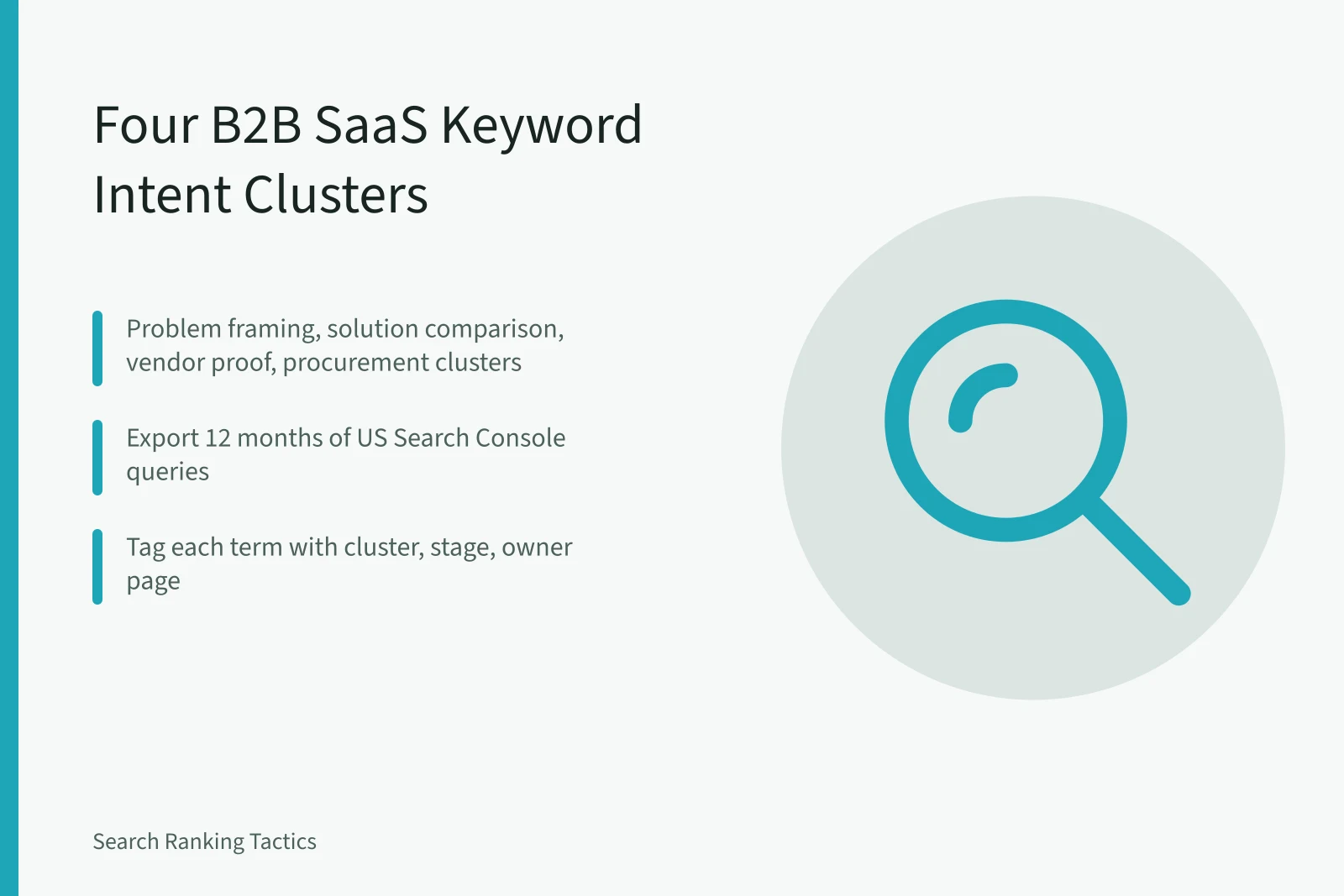
- Four clusters carry most US B2B SaaS demandproblem framing, solution comparison, vendor proof, and procurement.
- Give every cluster one owner page, one next step, and one metric that lives in the CRM.
- Refresh the wording every quarter, because AI summaries change the phrases buyers type.
- Sourcing and tooling decisions belong in a separate keyword research guide.
Start with buyer questions, not keyword lists
B2B SaaS purchases pass through several people before a contract appears. The Wikipedia overview of business-to-business trade describes long cycles and multiple approvals, which is why one keyword rarely maps to one buyer.
Gather raw questions from sales call notes, support tickets, G2 and Capterra reviews, Reddit threads, and the Queries report in Google Search Console. Rewrite each item as the phrase a buyer would type.
Then sort by the job the buyer is finishing. "How do teams reconcile invoices" belongs with problem framing. "Best invoice tools for a 200 person finance team" belongs with comparison.
Four clusters that map to pipeline stages
| Cluster | Query shape | Pipeline stage | Page that should rank |
|---|---|---|---|
| Problem framing | how do teams handle X | Awareness | Explainer or glossary |
| Solution comparison | X vs Y, best tools for Z | Consideration | Comparison page |
| Vendor proof | brand plus reviews, pricing, security | Evaluation | Case study or trust page |
| Procurement | brand plus contract, DPA, SLA | Decision | Pricing or legal page |
Each cluster needs one measurable next step. Problem framing points to a template download. Comparison points to a demo. Vendor proof points to a reference call. Procurement points to a pricing conversation. Track the resulting stage change in the CRM.
Pulling US query data from real sources
- Export twelve months of Search Console queries filtered to the United States.
- Pull wider lists from Ahrefs, Semrush, or Google Keyword Planner, then drop terms that fit a different business model.
- Tag each surviving term with a cluster, a stage, and the single page that should rank.
- Ask five sales reps which questions delay deals, and add phrasing missing from the export.
- Attach a value band to each cluster using average contract value in HubSpot or Salesforce.
Keep every export dated. US B2B search queries move with product launches, funding rounds, and compliance deadlines.
Example: one cluster, one owner page
A mid-market analytics vendor kept losing deals during late stage security review. Buyers searched phrases like "is [vendor] SOC 2 compliant" and "analytics security questionnaire". Both belong to vendor proof. One page answered them with a sample questionnaire and a compliance summary, and reps began sending that link during evaluation.
The cluster looked small inside a volume tool. Its queries sat one step from signature, which made it worth building first.
Sizing clusters against pipeline value
Keyword tools report demand, not revenue. Pair each cluster with the conversion rate of its owner page, then forecast pipeline instead of sessions. The Wikipedia entry on lead generation explains why a form fill and a qualified opportunity measure different things.
Finance teams accept a plain return on investment calculation, and the standard formula gives a defensible number for a planning meeting.
Pages that also serve Canadian buyers need their own consent wording and province level business listings, which sit outside a US cluster map.
Where scope and tooling decisions land
A cluster map settles what to write and which stage it serves. It does not settle how many markets to cover, which sources to trust, or how to record limits on each number. Once the cluster map is agreed, the hype-free keyword research guide carries the scope and tooling decisions, keeping each source unit, market, date, and validation plan attached to its claim.
Common questions
How many intent clusters does a US B2B SaaS site need?
Most teams manage with four to six. Start with the four pipeline clusters, then split one only when a single owner page cannot answer every query inside it.
Should I pay for Ahrefs, Semrush, or neither?
Search Console covers your own queries at no cost, so start there. Paid tools help with competitor gaps and volume bands, and Google Keyword Planner gives rough ranges for free.
How often should clusters be refreshed?
Quarterly suits most teams. Pull a fresh Search Console export, review new sales objections, and retire pages that no longer match buyer language.
Do AI answers make keyword research pointless?
No, but they change the shape of demand. Buyers still type problem statements, and those queries now feed both classic results and AI summaries, so every cluster still needs an owner page.