Reviews
Part of The honest guide to SEO strategy, 2027 edition
Twelve SEO strategy tools compared on data, scale, and cost
SEO strategy tools in 2027 should be compared by decision, source data, site scale, limits, exports, access, security, cost, and required human verification.
What to take away
- This unpaid, non-ranking list describes 12 tool or workflow options; features, packages, limits, and prices require a dated first-party check.
- Select a tool for a defined decision and known evidence gap, then verify its findings against live pages, logs, customer records, and search documentation.
- Test representative workflows, data ownership, access, export, security, accessibility, support, total cost, and exit before committing.
SEO strategy tools should answer a defined question. This unpaid list has no universal winner.
1. Google Search Console
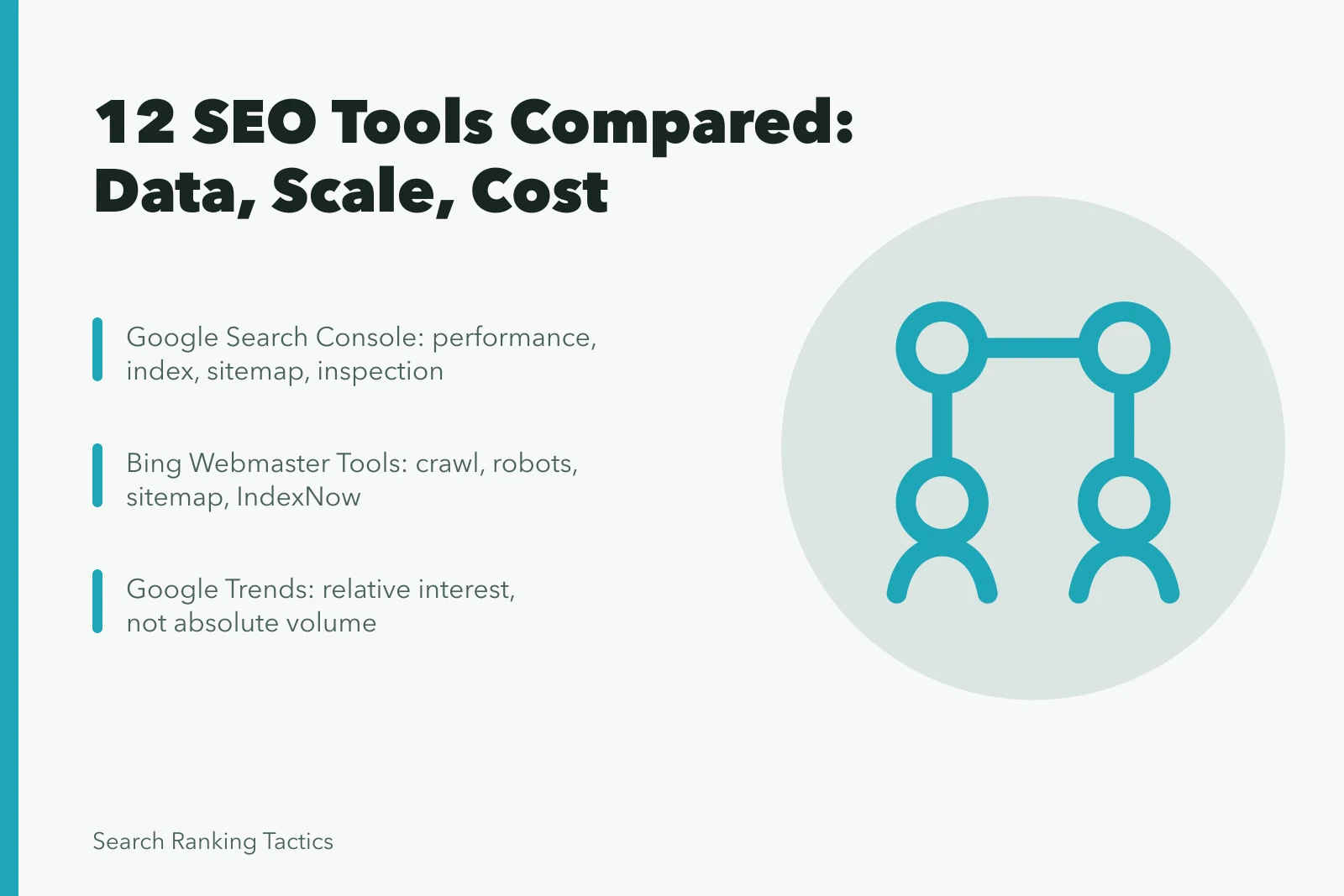
Use Google Search Console for selected performance, index, sitemap, inspection, and issue questions. Preserve property, role, filters, dimensions, dates, export, and limits, then reconcile findings with live pages and customer records.
2. Bing Webmaster Tools
Use Bing Webmaster Tools for selected performance, crawl, index, inspection, and diagnostic work. Microsoft's Bing Webmaster Tools setup guide describes verification plus performance, inspection, robots, crawl, sitemap, and IndexNow capabilities. Verify availability and definitions in the intended account before reporting.
3. Google Trends
Use relative interest to compare topics, places, and periods. Record normalization, sampling, categories, low-volume gaps, seasonality, and extraction date. It is not absolute volume or a forecast.
4. PageSpeed Insights
Use it to inspect available field and laboratory performance data.
5. Lighthouse
Use Lighthouse for controlled laboratory audits. The official Chrome Lighthouse overview explains supported execution routes and reports. Record version, device, network, page state, and environment. A lab audit identifies test leads; it does not establish search position or business effect.
6. Rich Results Test
Use a supported structured-data test to find syntax and eligibility issues. Passing does not guarantee a search feature.
7. Screaming Frog SEO Spider
Use a governed crawler to inventory URLs, responses, directives, canonicals, links, metadata, and rendered elements. Set boundaries, rate, credentials, and retention, then verify findings on live pages before template changes.
8. Sitebulb
Use a second audit workflow when its visualization or collaboration fits the team. Test the same known URL set and compare coverage, false positives, rendering, exports, access, support, cost, and portability.
9. Ahrefs
Use a third-party database for discovery, link analysis, competitor questions, and directional estimates. Record geography, date, database, metric definition, coverage, and validation because its index differs from first-party sources. Third-party indexes differ from first-party data, so confirm what the SEO strategy checklist says about evidence before you trust any estimate.
10. Semrush
Use another research suite when its workflow fits keyword, competitor, content, link, or audit questions. Estimated traffic, volume, difficulty, visibility, or authority are proprietary measures that need first-party validation.
11. Moz Pro
Use a rank, crawl, keyword, or link platform when its market, device, history, and export controls match the decision.
12. Server-log analysis
Use governed logs to observe server requests, responses, timing, and URLs. Verify legitimate crawlers, restrict sensitive fields, control retention, and distinguish a request from indexing, presentation, ranking, or customer value.
Choose a stack by evidence
List the decision, required source, scale, rendering, markets, exports, access, security, support, cost, and exit.
Decision table
| Tool question | Proof-of-concept task | Reject when |
|---|---|---|
| Coverage | Compare a known representative URL set | Important classes disappear |
| Accuracy | Verify findings against live evidence | False positives cannot be traced |
| Workflow | Complete one real investigation | Exports or ownership are blocked |
| Control | Test roles, logs, retention, and exit | Access is broader than necessary |
| Economics | Price full annual use and human review | Cost exceeds decision value |
Test the operating burden
The GOV.UK technology selection guidance recommends adaptable choices, data control, security review, and ownership-cost analysis. Use those public-service questions when assessing SEO strategy tools; they are not product endorsements.
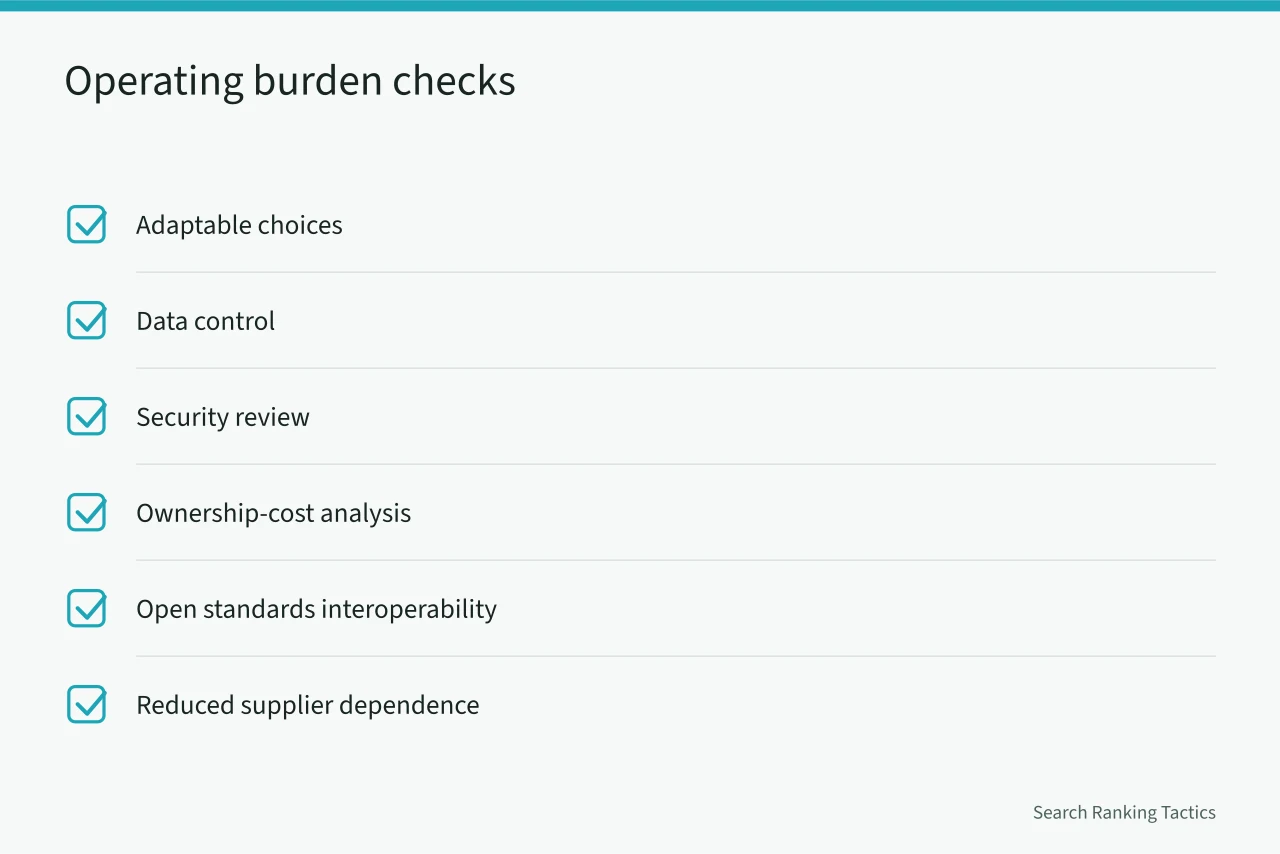
The GOV.UK open standards guidance links open standards with interoperability and reduced supplier dependence. Test whether SEO strategy tools data and definitions can move, while keeping the page's UK public-service context clear. Teams comparing SEO strategy tools should also weigh data ownership and exit costs against the benchmarks in our SEO strategy benchmarks guide.
Common questions
What is the best SEO strategy tool?
There is no universal winner. Choose the smallest reliable stack that answers the defined decisions and fits site scale, evidence, workflow, security, export, support, cost, and exit.
Can an SEO audit tool prove a ranking problem?
No. It can identify conditions and hypotheses. Verify the live implementation, search-system evidence, customer effect, competing causes, and decision before correcting it.
How should SEO tools be tested?
Use a representative URL set with known conditions, compare coverage and false positives, complete a real workflow, export the data, test roles, and price the human review.