Careers
A current couples page keeps aging long after it is published
Current couples history: why an accurate page turns false with age, the writing habits that let text carry its own date, and when to reframe it as past.
"Current" is a promise with an expiry date, and almost nothing published on the internet acknowledges having one.
A page describing a present situation makes its claim afresh for every reader who arrives: today, next year, and five years after the last person looked at it. The words do not change, but the world does.
What to take away
- Imagine the page found by someone with no context, at an unknown remove from when it was written.
- At some point a page about a current situation should stop claiming to be one.
- The instinct when updating is to make the page read as though it had always said the current thing.
Nothing here was wrong when it was written
It is worth being precise about the failure mode, because it is not carelessness.
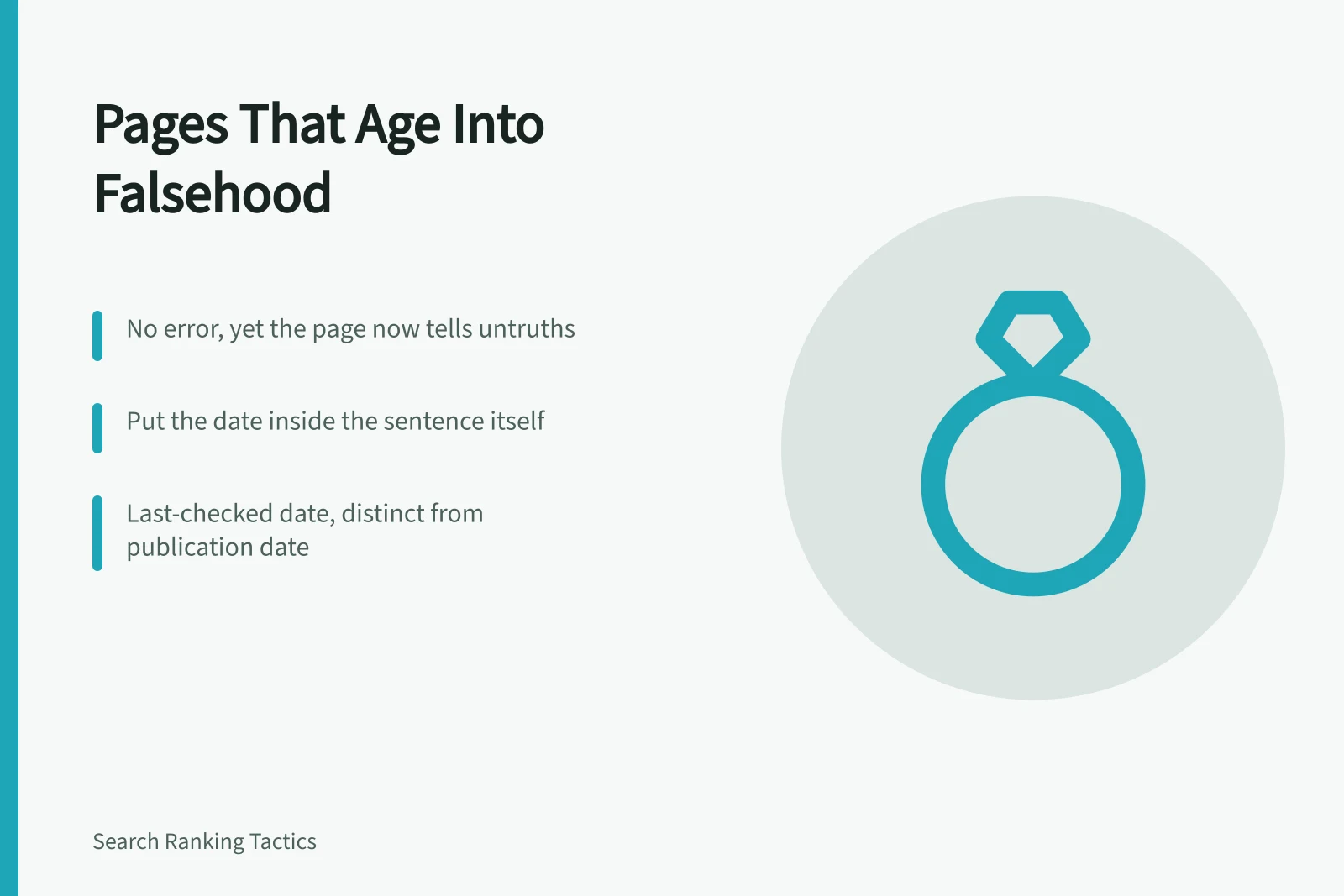
A piece is researched properly, sourced properly, and published accurately. Then it sits. A year later the situation has changed and the piece has not. It now tells readers something untrue, while every sentence in it remains as defensible as the day it went up.
No correction fixes this, because there was no error. What fixes it is structure: text that carries its own timestamp, and a process that revisits it.
Write text that ages honestly
Four habits, in rough order of value.
Four habits that age honestly
- Put the date in the sentence
- Use past tense for past things
- Never write in relative time
- Say what you do not know
Put the date in the sentence. "As of [date], they are married" survives being copied, scraped, translated, and stripped of its page furniture. A publication timestamp in the page margin survives none of that, and neither does the page itself without the deliberate effort that web archiving exists to supply.
Here is that habit as a before and after. The line as first written, in March 2024: "As of March 2024, they are married."
The same line after a review in March 2026, with nothing new to report: "As of March 2024, they are married. No change has been announced as of March 2026." The date travels with the sentence. A page timestamp does not.
Use the past tense for past things. "Married in [year]" is permanently true. "Are married" needs re-earning every day, which is the whole argument of the main guide to current couples. Most facts on a chronology can be expressed as events, and events do not decay.
Never write in relative time. "Recently", "last year", "currently", "now", "this month": every one of these is a landmine that detonates on a date you will not be present for. Use absolute dates, always.
Say what you do not know. "No change has been announced as of [date]" is genuinely informative and stays informative. A silent gap tells the reader nothing, and they will fill it with the assumption that nothing has changed.
What a reader in five years actually needs
Imagine the page found by someone with no context, at an unknown remove from when it was written. They need to answer three questions from the text alone:
- What was the status, and as of what date?
- What documented that status, and where can it be checked?
- What has changed since, and what is still unconfirmed?
Three questions a reader needs
- When was this true? The currency date
- Who established it? Named sources
- Has anyone looked since? Last-checked date
If those three are present, the page ages into a dated historical record, which is fair and useful. If absent, it ages into a false present-tense claim. Readers cannot tell which kind they have landed on.
A page can be accurate line by line and still leave an impression its sources never supported. That is the situation the doctrine of false light describes.
The transition from current to historical
At some point a page about a current situation should stop claiming to be one. The trigger is usually one of:
- Something was announced that changes the status
- A defined period has passed with no confirmation, and you cannot honestly assert currency any more
- You have stopped maintaining the page
The third is the one nobody handles, and it is the most common. Pages get abandoned quietly, and a reader cannot tell a maintained page from one whose author stopped looking years ago. An abandoned page is exactly the case the current couples updates triggers are written to catch.
Pick an interval you can keep. A review every six to twelve months is a typical working rule, and any announcement that changes a status should trigger a check at once. Write the interval into the page, so the reader can see how stale it might be.
Handling it well takes very little:
| Step | What it looks like |
|---|---|
| Add a dated status line | "As of March 2026, no change has been announced." |
| Mark the entry superseded | "Superseded as of March 2026. Kept as a record of what this page said until then." |
| Change the tense | "Married in 2019" replaces "are married". |
| Note the last review date | "Last reviewed March 2026. Later changes may not appear here." |
Reframing an abandoned page
- Reframe the status line as of a date
- Leave the dated sourced rows alone
- Mark when the page was last reviewed
- Keep a note of the earlier framing
Nothing is deleted. The page moves from asserting the present to documenting the past, which is a change of framing rather than a change of facts.
Keep the earlier states
The instinct when updating is to make the page read as though it had always said the current thing. Resist it.
Keeping earlier states visible
- Keep dated notes of prior status fields
- Keep superseded entries visible as superseded
- Never remove an accurate historical row
A chronology's value is that it can be checked against itself over time. A page whose earlier states quietly vanished cannot.
It looks the same whether kept with care or rewritten to fit current belief. In a field where quietly changing your words is a serious charge, the audit trail shields the publisher at least as much as the reader.
In practice: keep dated notes of what a status field said before, keep superseded entries visible as superseded, and never remove an accurate historical row because it complicates the current picture. The guide to corrections covers how to do that without turning every page into a changelog.
What history is for here
There is a real distinction between recording that a relationship existed during a period and re-litigating it, and the same line runs through the main guide to dating timelines.
The first is legitimate and durable: dated events, named sources, plain language. The second is where old material becomes harmful, a historical entry that acquires a narrative, an ending that acquires a cause, a period that acquires a characterization nobody ever gave it.
The discipline is the same as at the time of writing: record what was established. Do not explain, interpret, or resolve.
The passage of time makes speculation feel safer because the people involved have moved on and nobody is watching, but it does not make it better supported.
What changes when a couple moves into the past tense is covered in the notes on former couples.
Common questions
How long can a "current" page stay current without a check?
Only as long as you are prepared to say so in the text. There is no correct interval; there is only the requirement that the reader can see what yours has been.
Should an old page be deleted once it is out of date?
No, if it was accurate. Reframe it and date it. Deleting accurate history to keep a site tidy removes the record and leaves the copies elsewhere standing uncorrected.
Does a page timestamp count as a currency date?
Not reliably. It is often the date of the last technical change rather than the last editorial review, and it disappears whenever the text is copied. Put the date in a sentence.
What if the page has not been reviewed in years?
Say so, on the page, and either review it or reframe it as historical. An honest statement that a page is stale is worth more than a page that looks maintained and is not.