Strategy
Local SEO checklist for short-term rental owners owners
Local SEO for short-term rental owners answers a different search than guests run: it reaches property owners looking for a manager, not travelers.
What to take away
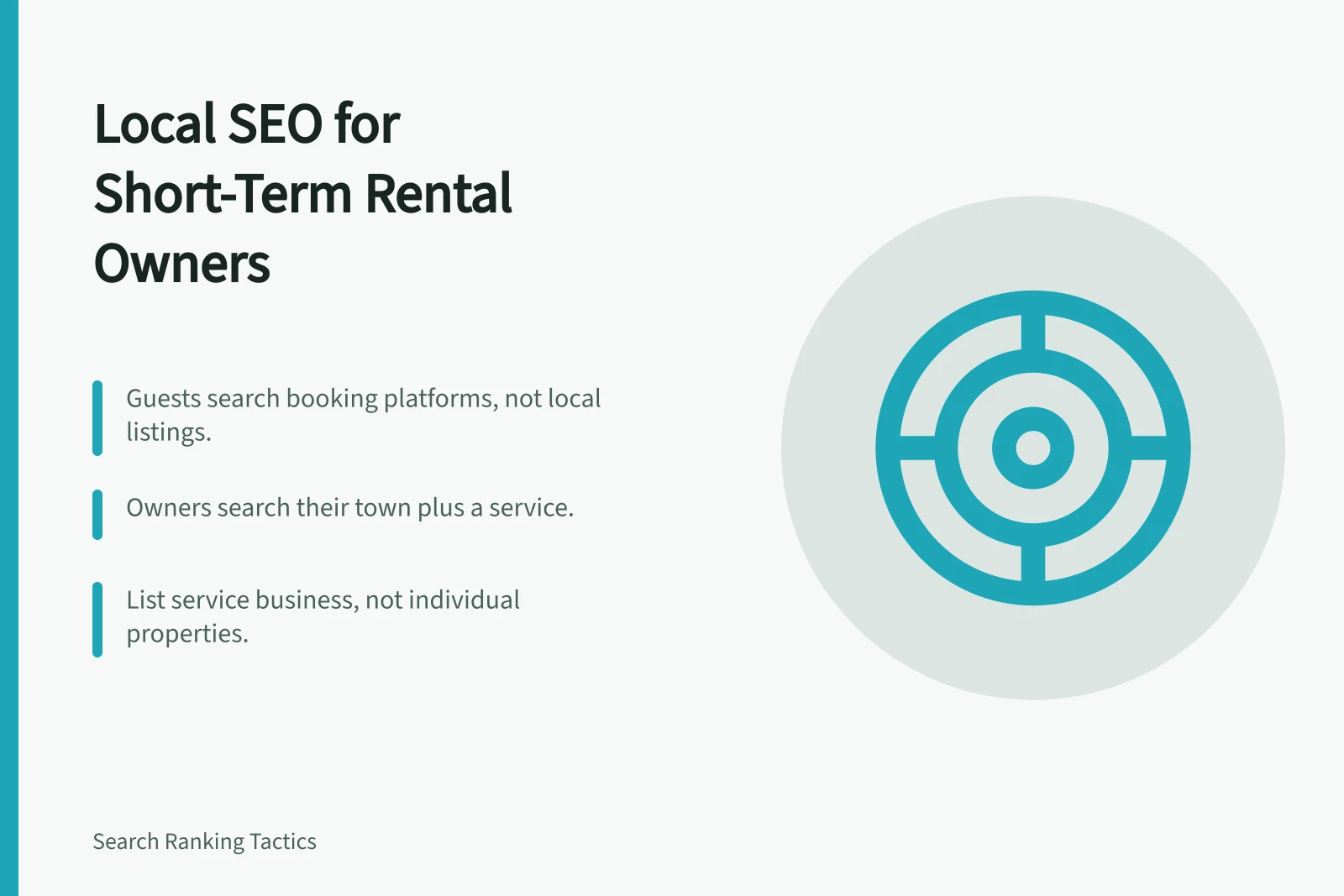
- Guests searching for a place to stay mostly do it inside booking platforms.
- What local search genuinely reaches is property owners looking for a manager in their own town. That is a much smaller audience and a far more valuable one.
- Optimize for the owner search, not the traveler search. They use different words and want different pages.
- Reviews on a business profile are a professional signal here, and the rules around soliciting them are narrower than most operators assume.
Two different searches
Someone planning a trip searches inside a booking platform, or searches a destination and lands on one. Very little of that demand reaches a local business listing, and no amount of local optimization redirects it.
Traveler vs owner search
The traveler search
- Where it happens
- Booking platforms
- Volume
- High
- What they want
- Property photos
- Local optimization
- Very little
- Value per conversion
- One booking
The owner search
- Where it happens
- General search engine
- Volume
- Low
- What they want
- Real business evidence
- Local optimization
- Most of the work
- Value per conversion
- Revenue line for years
Someone who owns a property and is tired of managing it searches differently. They search their own town plus a service, they read the results carefully, and they are trying to work out whether a real business exists behind each one.
That second search is the one worth winning. It has low volume, high intent, and a value per conversion that is not comparable to a booking, because an owner account is a revenue line lasting years rather than nights.
The traveler search
- Where it happens
- Mostly inside booking platforms
- Volume
- High
- What they want to see
- Photographs and reviews of a property
- Value of one conversion
- One booking
The owner search
- Where it happens
- A general search engine, in their own town
- Volume
- Low
- What they want to see
- Evidence a real business exists
- Value of one conversion
- A revenue line lasting years
Which audience you are addressing is the first decision, and the general argument for splitting them is in the marketing and growth guide.
What actually influences a local result
Google publishes its own notes on improving your local ranking, which is the authority on how its business profiles work and is worth reading directly rather than through anybody's summary.
What is worth saying here is what it means for this specific trade.
Your business is a service business with an office or a service area, not a set of properties. Listing individual rental properties as business locations is the most common error and it is the wrong shape entirely. One business, one profile, categorized as what you actually do.
The primary category is typically Property management company, with Vacation home rental agency as a secondary. Fill in every field the profile offers: business name, address or service area, phone number, website, opening hours, the description (750 characters) and the attributes that describe what you offer.
The service area matters more than most operators think, because it is also your route density statement. A profile takes a service area list of typically up to 20 entries.
Claiming a service area you cannot actually service on a Saturday morning attracts owners you will have to decline, or worse, accept.
And the information has to be accurate everywhere it appears. Inconsistent details across a website, a profile and a directory are both a ranking problem and a credibility problem, and the second one is the reason to fix it.
The pages an owner search needs
An owner is trying to answer four questions, and each deserves its own page rather than a paragraph.
Four pages an owner needs
- What you do, itemized, including exclusions
- What the owner receives monthly, real example
- How you handle local rules and permits
- Who you are, with someone to vouch
- What can my property earn?Publish the occupancy and nightly rate range you achieve in their town, and the month those figures cover. A range without a date is a promise, not evidence.
- How will it be run and reported?This is the page that converts. A real monthly report, anonymized, does more than any amount of copy about professionalism.
- Is short-term renting allowed at my address?This is the page that separates operators in this trade. An owner who is nervous about whether the use is even permitted at their address is reassured by a manager who describes the process of establishing it rather than one who asserts an answer. The method behind that page is the licensing and compliance guide.
- What does it cost, and how do I start?Name the management fee and what it covers, then the three steps from first contact to a live listing.
Reviews, on a business profile rather than on a listing
Guest reviews live on the platforms. Reviews on your own business profile come from a different group: property owners, and sometimes vendors.
Those are the ones an owner reads before calling you, and there are usually very few of them, which makes each one matter.
Ask for them the same way from everybody, without incentives and without asking only the people you expect to be positive. The boundary here is narrower than most people assume, and the Federal Trade Commission's guidance on soliciting and paying for online reviews covers arrangements that many operators would not think of as paid at all.
A request that works: "If we looked after your property well, a short review on our Google profile helps the next owner decide." Send it within two weeks of the first clean turnover, and reply within 48 hours.
Respond to every review, briefly. On this profile the response is being read by owners who are assessing how you handle a complaint, which means the tone of the reply is doing more work than the reply's content.
What not to spend time on
Three things absorb effort in this trade and return little.
What not to spend time on
- Chasing traveler search terms
- Separate location pages per property
- Volume content about destinations
- Chasing traveler search terms. That demand lives elsewhere and the pages you build for it will not be read.
- Building separate location pages for every property. It is the wrong entity shape, it dilutes the one profile that matters, and it produces pages nobody searches for.
- Volume content about destinations. It attracts readers who are not owners and cannot book with you anyway.
The time saved is better spent on the four pages above, and on the channel that actually produces owner accounts, which is other owners. Why the referral route outperforms search for this audience is set out in how to win more short-term rental property owners.
Claims on your own pages
Everything on a website you control is a claim, including the quiet ones.
Numbers of properties managed, years in business, coverage described as complete, and any statement that you are licensed or registered where an application is pending. These are the ones an owner will check, and a manager caught overstating something small loses the account over the small thing rather than over the large one.
Say only what you can evidence, and keep the evidence in the same register that holds your compliance answers.
Getting found in a second market
Opening in a new area restarts this entirely. A new service area, a new set of local signals, no local reviews, and no owners to refer you.
That is a genuine cost and one reason a second market costs more than a second property, as argued in the expansion and market guide.
Check you can staff a new area before you advertise into it. Winning an owner in a market with no cleaners is a problem, not a win. See the hiring and training guide.
Common questions
Will local search fill my calendar?
No. Guest demand for nightly stays does not run through local business results in any meaningful volume, and building for it is the most common wasted effort in this trade.
Should each property have its own web page?
Only if you take direct bookings and want a page to send people to. It is not a local search strategy.
How many owner reviews do I need?
A handful of genuine ones outperform many thin ones. This audience reads them rather than counting them.
Is it worth paying an agency?
Only if they understand that your customer is a property owner. An agency optimizing for traveler search is solving a problem you do not have.
How long does any of this take?
Longer than referrals, which is why referrals should be the primary channel and search the supporting one.