Strategy
Part of Keyword research, minus the hype in 2027
Keyword research trends: clustering and outcomes replace raw volume counts
Keyword research trends in 2027 include AI exploration, first-party language, more search surfaces, local markets, low-volume tasks, governed clusters, and outcomes.
What to take away
- AI can accelerate term exploration, but people remain responsible for sources, settings, customer meaning, page decisions, accuracy, and risk.
- First-party language and market-specific work matter more as generic suggestions become easier to produce and search behavior spans more surfaces.
- Govern clustering as destination design and judge research through qualified outcomes, not the size of a suggestion file.
Keyword research trends should improve a decision, not create a new pile of suggestions. The 2027 shifts below extend current search-platform changes and durable research needs. Treat them as planning signals, verify current product status, and use bounded tests with documented methods.
AI assists exploration, while humans own the method
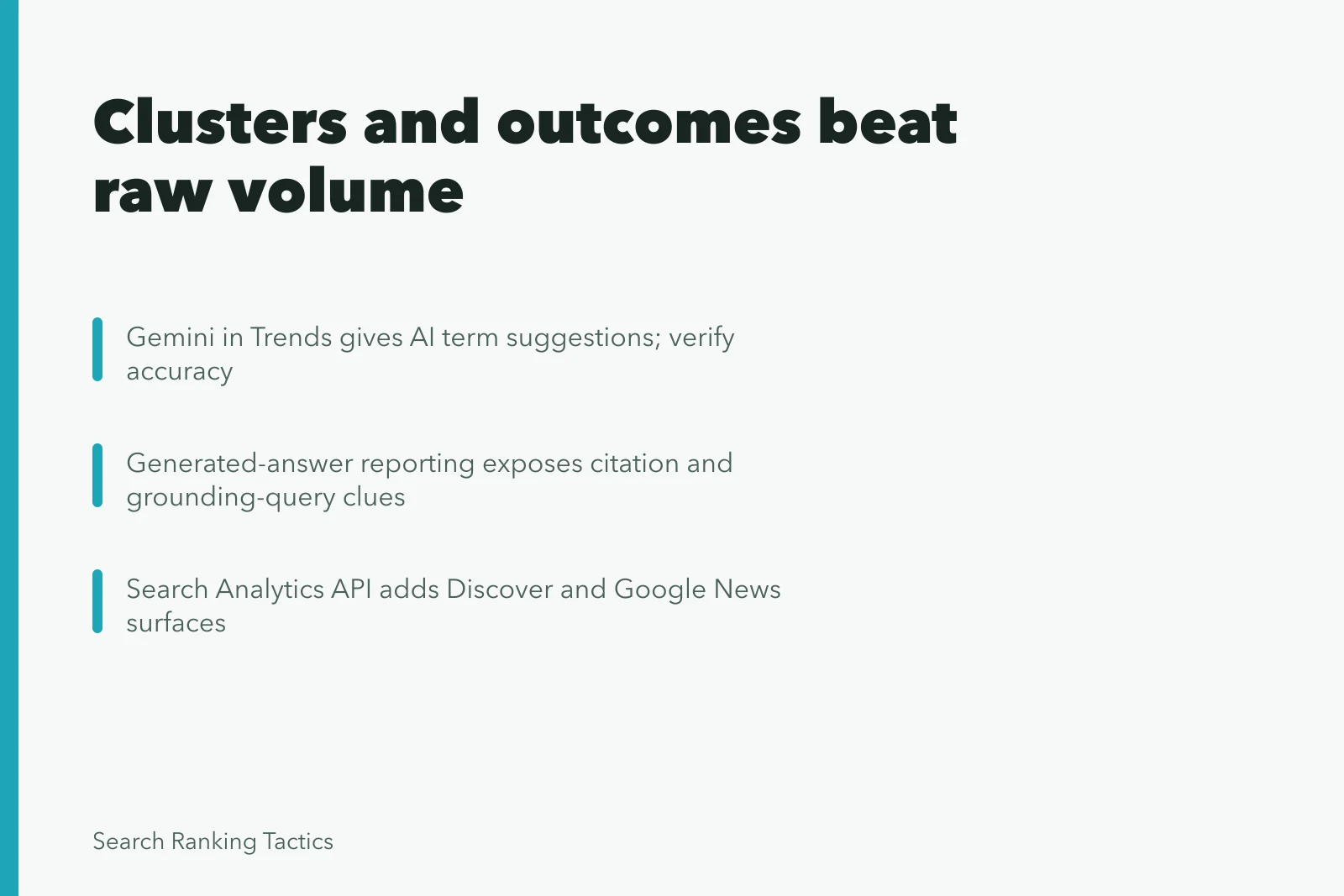
Google's Gemini features in Trends documentation describes experimental AI-assisted term suggestions and warns that generated information can be inaccurate. Use the feature for exploration, retain the prompt and selected terms, verify every interpretation, and keep people responsible for market, customer, destination, and publication decisions.
Generative-search data adds new query clues
Generated-answer reporting can expose citation and grounding-query clues in supported products. Treat these as product-specific, sampled diagnostics with changing coverage.
First-party language becomes more valuable
As generic suggestions become easier to generate, sales, support, site search, reviews, product use, interviews, and owned search evidence become more useful differentiators.
Research spans more search surfaces
Web, image, video, news, shopping, maps, marketplaces, social search, and generated answers can reveal different tasks and destination needs. Google's Search Analytics API update for additional surfaces documented Discover and Google News data plus regular-expression support, while noting that dimensions vary by search type. Preserve surface-specific definitions and do not blend unlike visibility records into a universal demand number.
Search surfaces and their data
Surface
- Web
- Search Analytics API
- Images
- Search Analytics API
- Video
- Search Analytics API
- News
- Google News data
- Shopping
- Search Analytics API
- Maps
- Search Analytics API
- Discover
- Discover data
Data source
- Web
- Yes
- Images
- Yes
- Video
- Yes
- News
- Yes
- Shopping
- Yes
- Maps
- Yes
- Discover
- Yes
Definition kept separate
- Web
- Images
- Video
- News
- Shopping
- Maps
- Discover
Market-specific research replaces translation
Terms, concepts, spelling, products, regulation, currency, seasons, and result patterns vary across countries. A literal term and a broader cross-language concept can answer different research questions. Use qualified local reviewers and confirm the business can actually serve the market.
Zero-volume tasks receive more scrutiny
Sampled, ranged, or modeled tools can hide new and narrow demand. Product launches, enterprise problems, regulated questions, and support errors may still be valuable.
Clustering becomes destination governance
Automated semantic clustering will continue to reduce sorting time, but page decisions require offer knowledge, intent, results, architecture, and evidence. Track false merges, false splits, competing URLs, and the downstream quality of briefs rather than celebrating cluster count.
Keyword success moves toward outcomes
Position and estimated volume remain diagnostics. The useful chain runs from a customer task and appropriate destination through visibility, visit quality, qualified action, contribution, and learning. Preserve missing data, attribution limits, maturity, seasonality, and concurrent changes before claiming value.
Prepare by inventorying sources, tool contracts, fields, automation, country coverage, owners, and validation. Choose the shifts that solve known research problems. Keep raw data and portable exports so the business can change methods as platforms evolve. A keyword research benchmark should score source coverage and cluster agreement, not suggestion counts.
Decision table
Bounded response
- AI exploration
- Verify terms, meaning, sources, and outputs
- First-party language
- Govern consent and connect it to tasks
- More surfaces
- Keep definitions and destinations separate
- Market specificity
- Use local evidence and reviewers
- Outcome focus
- Connect release to qualified value
Do not infer
- AI exploration
- Generated suggestions are market truth
- First-party language
- Every phrase needs a page
- More surfaces
- All visibility units are comparable
- Market specificity
- Translation proves demand
- Outcome focus
- Volume alone defines priority
Maintain a dated watchlist
The NIST AI RMF Playbook offers voluntary AI-risk actions under govern, map, measure, and manage. Use them when AI changes keyword research trends; the playbook is not a product ranking or forecast.
The W3C Privacy Principles statement gives web-system designers shared privacy concepts and warns against shifting privacy work to individuals. Apply it to keyword research trends, then review the governing law and configuration. A solid keyword research checklist keeps privacy duties with the team instead of pushing them onto individual users.
Common questions
Will AI replace keyword researchers in 2027?
It can accelerate exploration and organization, but people still own customer meaning, evidence, source limits, destination decisions, accuracy, governance, and business risk.
Why is first-party language more important?
It reflects actual customer and product contexts that generic suggestion systems may miss, though it still requires consent, classification, and careful interpretation.
How should a team respond to keyword research trends?
Choose only the shifts that affect a real decision, define a reversible test and stop rule, preserve the method, and review qualified outcomes on a fixed date.