Costs
Part of The honest guide to SEO strategy, 2027 edition
A realistic take on SEO strategy best practices in 2027
SEO strategy in 2027 rests on crawl eligibility, original evidence, safe releases and outcome measures, not on ranking guarantees or shortcuts.
What to take away
- Search Console shows eligibility and presentation, not position. Treat indexing, rich results and AI citations as outcomes you test, never as deliverables.
- Decide what a page is for before you build itaudience, task, next action, and the business result that proves it worked.
- Fix crawl, render, canonical and sitemap problems before publishing more pages. Volume on a broken architecture multiplies the problem.
- Give every release an owner, an acceptance test, a customer guardrail and a rollback path.
- Annotate migrations, campaigns and seasonality, or you will read a calendar effect as a ranking win.
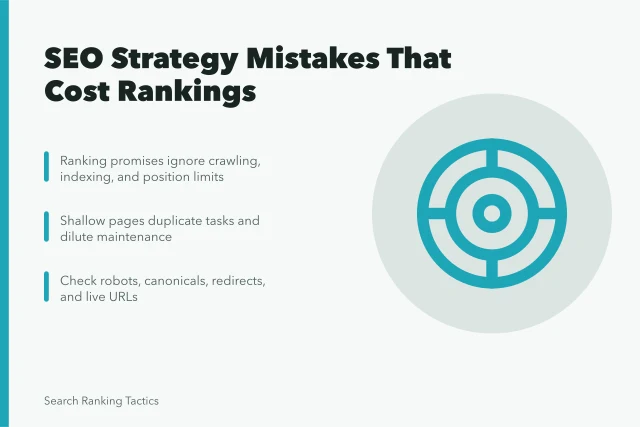
SEO strategy is a set of operating principles you test on live pages. Google's documentation describes what its systems support and how to stay eligible. It does not promise crawling, indexing, a rich result, a citation or a position, and neither should your plan.
Start from the outcome, not the keyword list
Name the customer, the market, the task and the next action the page should produce. Then name the business result: qualified leads, booked jobs, applications, resolved support tickets, revenue.
From Customer Task to Business Result
- Name customer, market, task, next action
- Define business result: leads, jobs, applications
- Resolve support tickets and revenue
- Treat search visibility as diagnostic only
- If impressions rise but leads fall, wrong task
Search visibility is a diagnostic. If impressions rise while qualified leads fall, the page is attracting the wrong task. Do not reward traffic the business cannot serve, and do not let a rank report stand in for a sales number.
Make the page eligible before you make it pretty
A page that cannot be crawled, rendered or canonicalised is invisible no matter how good the copy is. Check valid responses, crawlable links, deliberate robots controls, and rendering.
Page Eligibility Checks
- Valid responses
- Crawlable links
- Deliberate robots controls
- Rendering
- Canonical signals
- Redirects
- Sitemaps
Google's guidance for web developers supports crawlable links, sitemaps, URL inspection, semantic HTML and accessible DOM text. Test representative live pages rather than templates. Technical validity does not prove indexing or value, so confirm crawl access and architecture before committing to a full SEO strategy checklist.
Research queries where customers already talk
Pull query data alongside customer interviews, site search, sales calls, service tickets and product knowledge. Combine close wording when the intent, the evidence and the action match. Split only when a real audience, product, location or task difference needs its own experience.
Combine or Split Query Targets
Combine
- Intent
- Same intent
- Evidence
- Same evidence
- Action
- Same action
- Audience
- Same audience
- Location
- Same location
Split
- Intent
- Different intent
- Evidence
- Distinct evidence
- Action
- Different action
- Audience
- Own audience
- Location
- Own location
Interview transcripts beat keyword tools on one thing: the words customers use when they are stuck. Those words belong in headings.
Publish evidence someone could check
Write for a defined audience and task. Use original information, direct experience and transparent methods. State sources, dates, corrections, commercial relationships and limitations where a reasonable reader would expect them.
Structured data belongs only where it matches visible content and a supported feature. Google's structured-data guidelines cover relevance, completeness, access and format, and state that valid markup does not guarantee a rich result. Build the page so it still works when the enhancement does not appear.
Test the page as a customer, not as a crawler
Check these accessibility and performance areas:
Test the Page as a Customer
- Keyboard use
- Zoom
- Forms
- Media alternatives
- Mobile layout
- Speed
- Security and consent
A fast page nobody can understand is not an optimisation. Accessibility testing and resilience testing catch the failures that ranking dashboards never show.
Release, annotate, then judge
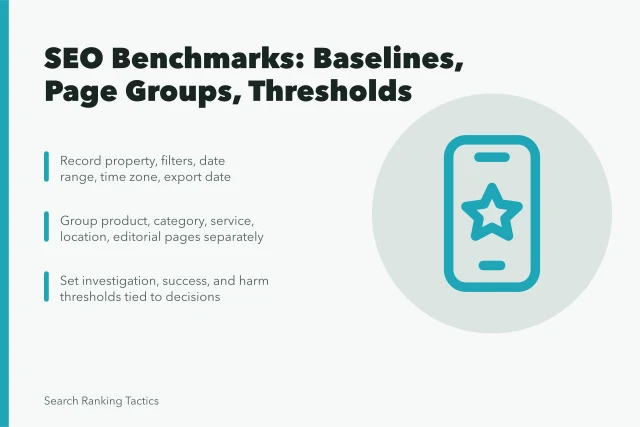
Write down the issue, affected URLs, evidence, and expected mechanism. Also write down the acceptance test, guardrail, release date, and review date. Segment results by page role and maturity.
Annotate migrations, campaigns, tracking changes, seasonality and confirmed search updates. Two events happening together is not causation, and an unannotated December will look like a strategy win. Teams that sequence changes this way avoid the most common SEO strategy mistakes, ranking promises and vanity metrics among them.
Watch generated answers as a separate surface
Track conventional search performance and generated-answer visibility where the relevant system reports it. Keep each report's definitions, coverage and limits attached to the number.
Facts stay current, ambiguity gets cut, and the destination has to be worth using beyond a summary. Then connect that visibility to qualified customer and business outcomes.
Decision table
| Practice | Acceptance evidence | Outcome check |
|---|---|---|
| Purpose | Audience, task, page role, next action | Qualified customer progress |
| Eligibility | Live crawl, render, canonical, links | Index and presentation diagnostics |
| Evidence | Original method, sources, author, date | Trust, use, corrections |
| Experience | Keyboard, mobile, form, media, speed tests | Completion and harm signals |
| Release | Owner, log, guardrail, rollback | Business result and decision |
Assign the practice
The NIST Privacy Framework starting guide sets out a voluntary process for identifying and managing privacy risk. Use it to assign data and response owners. It is not legal clearance.
The CISA business-system logging guidance explains how event records support security review. Keep access, change, failure and correction records for your SEO systems, without treating a log as proof that a metric is right.
Common questions
What is the most durable SEO best practice?
Serve a real customer task with an accessible, accurate, original, maintained destination, then measure whether discovery supports a useful business outcome. Principles like that survive algorithm updates because they describe the customer, not the ranking.
Does valid structured data guarantee a rich result?
No. Valid markup can establish technical eligibility for a supported feature, and search systems still decide whether and how to display it. Build the page so it keeps its value when the enhancement never appears.
How should SEO best practices be governed?
Assign an owner, an evidence standard, an acceptance test, and a release record. Also assign a customer guardrail, an outcome window, a correction route, and a review trigger. Review the set when a migration, a tracking change or a confirmed search update lands.