Reviews
Part of Keyword research, minus the hype in 2027
Should you hire a keyword research agency without a controlled pilot first?
Best keyword research agencies in 2027 should be compared through one brief, assigned researchers, source transparency, market fit, security, price, and ownership.
What to take away
- No. Run a paid pilot on your own data before you sign a retainer.
- Give every shortlisted firm the same brief, the same sample task and the same deadline.
- A typical pilot runs 20 to 40 hours and costs about US$1,500 to US$6,000 as a market range.
- Score the raw exports and the clustering. Keyword file size means nothing.
- Keep accounts and raw data under your own ownership.
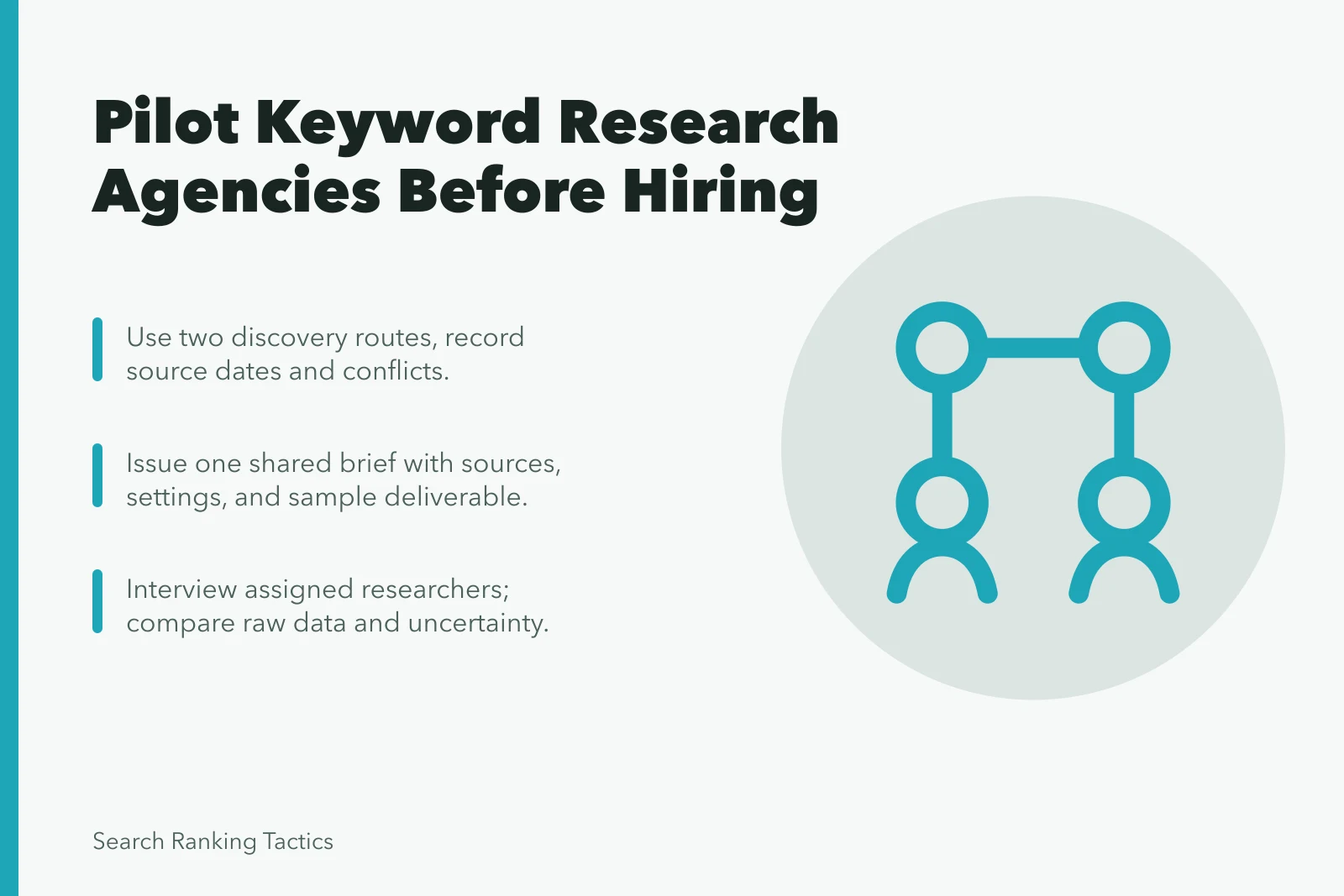
A sales pitch cannot show how a team handles messy first-party data, an ambiguous query, or a page serving two intents. A pilot can. Pay a small fee before the retainer and treat the pilot as the real interview.
Why a controlled pilot beats a proposal
Proposals come from sales staff. Delivery comes from researchers, often junior, working from a template. The gap between those roles is where weak keyword engagements begin.
The pilot also tests definitions. If the agency treats a tool's volume figure as demand, the raw export will show it. Keyword research, minus the hype in 2027 sets out where vendors inflate scope and how to catch it early.
Keep the pilot bounded: one market, one product line, one deliverable, one deadline. A pilot across six countries and four languages is a retainer under another name.
Example: a four-week pilot brief
Four-week pilot brief
- Week 1. Grant read-only access to analytics, Search Console and one paid keyword tool.
- Week 1. Agree the business question in one sentence, such as which 200 queries should own which category pages.
- Week 2. The agency returns raw exports showing source, units, pull date and tool settings.
- Week 3. The agency delivers clusters, intent labels, a page map and a ranked shortlist with exclusions.
- Week 4. Hold a 60-minute debrief. The researcher who did the work defends the reasoning and names the limits.
Send the identical brief file to every firm, so no team gets extra context.
Shared Research Brief Contents
- Business question, countries, languages, products
- Customer groups, existing data, site scale
- Destinations, outcomes, deadline, constraints
- Sources, databases, settings, first-party integration
- Cleaning, intent review, clustering, page mapping
- Prioritization, sample deliverable, limitations
- Security and update process
Expect one clarification round, not unlimited revisions.
Ask which database produced each number, because two tools rarely agree; keyword research tools compared on source, freshness, and export limits shows where the gaps sit. Budget two hours of your own time for access, a kickoff call and the scoring meeting.
Watch how the team handles a branded query and a common misspelling, because sloppy handling there repeats across the set.
The scoring rubric that decides the hire
The scoring rubric
| Criterion | What a strong answer looks like | Weight |
|---|---|---|
| Source transparency | Raw fields, units, pull dates and settings named | High |
| Assigned team | You meet the people doing the work | High |
| Cluster quality | Clusters map to pages, not to word counts | High |
| First-party integration | Your query and conversion data changes the output | Medium |
| Controls | Read-only access, export rights, exit terms | Medium |
| Price and time | Hours, rates and client-side hours itemised | Medium |
Use a 1 to 5 scale per criterion, and write a reason for anything below 3. Weight source transparency and assigned team highest, since a polished page map from a team you never met is a risk rather than a deliverable.
Fix thresholds before you open any file, or you will grade on presentation. Scoring a keyword research benchmark covers coverage, cluster and demand measures you can reuse from one pilot to the next.
What a pilot should cost
Pilots bill by the hour. A 20 to 40 hour pilot at common freelance or agency rates lands near US$1,500 to US$6,000. That is a typical range, not a fixed market price.
Quotes far below that usually mean a resold tool export. Quotes far above it usually bundle strategy you did not request.
Bring the number back to value. The return on investment formula is enough for a two-line business case: pilot cost against the value of one avoided retainer.
Where to find candidates and what a directory proves
The Ahrefs agency directory filters by service, location, industry, language and budget. Clutch and the search platform partner directories work as second routes. Treat each as discovery only, because this is a vetting method rather than a ranking of firms.
Record the date, filters, sort order, sponsorship and eligibility rules for every listing you shortlist. None of that is evidence of research quality.
Directory Discovery Checks
- Record the date and filters used
- Note sort order and review method
- Check sponsorship and eligibility
- Verify profile, team, and market
- Confirm references before contact
Objective performance claims need a reasonable basis under the FTC advertising substantiation policy. Reviews deserve similar scrutiny; the FTC guidance on soliciting and paying for reviews covers selective requests, incentives and hidden relationships.
Deciding after the pilot
Skip the pilot only when three conditions hold at once. The scope is 50 keywords with no page decisions. An internal researcher already covers the work. The vendor is on your site already.
Otherwise score the pilot within a week of the debrief. If it lands well, rebuild the brief as a keyword research checklist and reuse that file for the retainer.
Common questions
Which keyword research agency is best?
The one that solves your defined market and page problem with evidence you can inspect.
Should directory placement decide the shortlist?
No. Directories are discovery routes with changing eligibility and commercial terms.
What should the pilot deliver?
Raw exports, source fields, clusters, a page map, priorities, exclusions, ownership terms and a refresh plan.
How long should a pilot run?
Two to four weeks for one market and one product line.