Operations
Part of Keyword research, minus the hype in 2027
Solid keyword research follows a practical guide, not a single tool
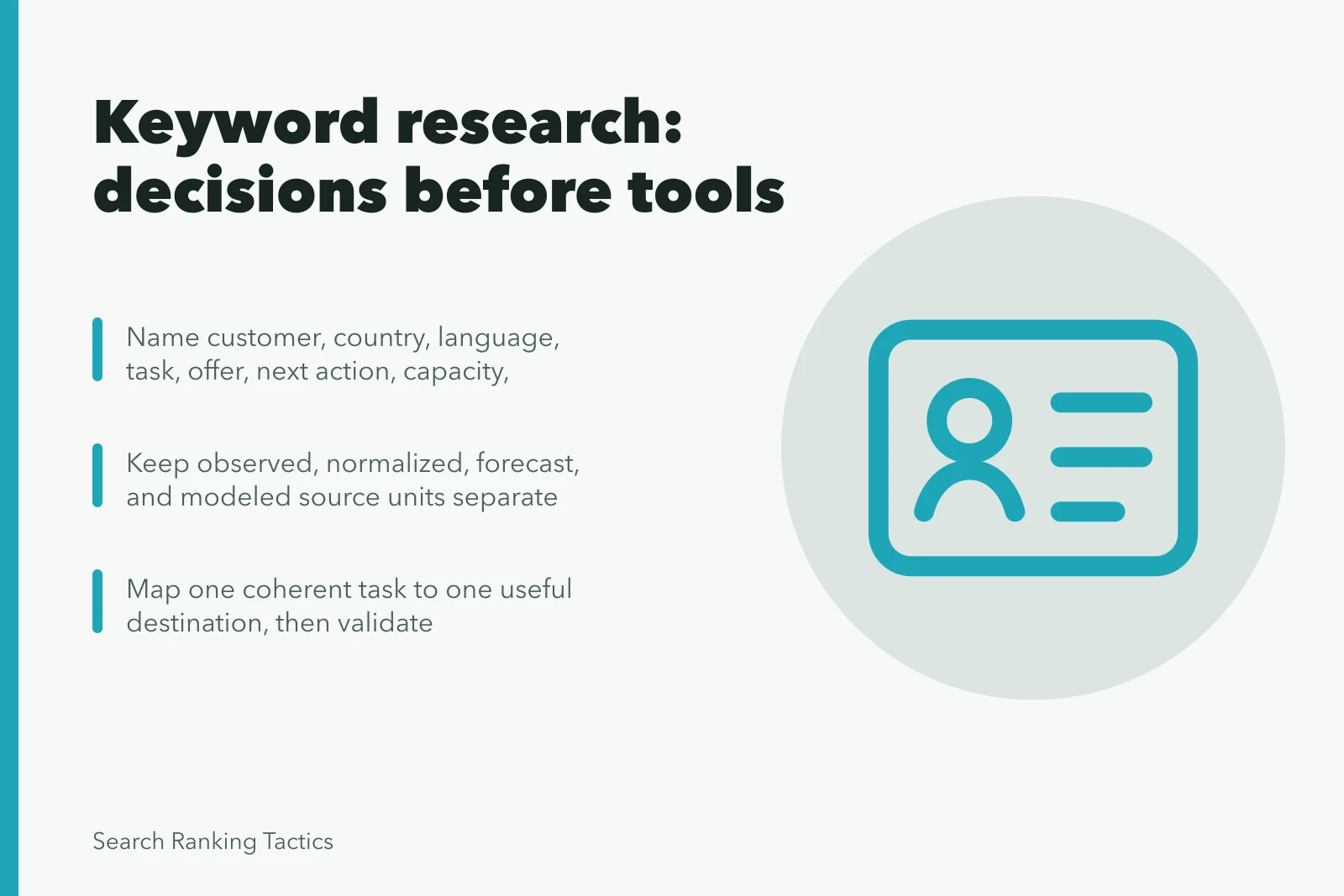
Keyword research best practices in 2027 start with decisions, combine customer and search evidence, preserve source units, map tasks to pages, and validate outcomes.
What to take away
- Fix the decision before you collect wordscustomer, market, task, offer, capacity, exclusions.
- Run three or more sources and keep their units apart. Owned query data, advertising estimates and trend indexes answer different questions.
- Cluster by destination, not by wordingone task, one page, one owner.
- Fill a brief with a primary query, supporting queries, exclusions and a measure, then test the release against observed queries.
Which tools cover which part of the job
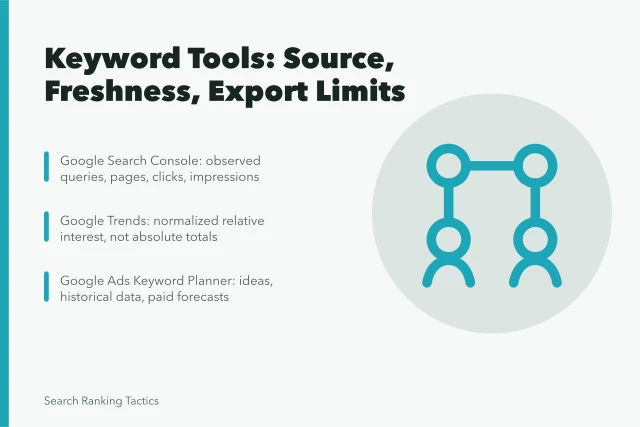
No single tool does keyword research. Google Keyword Planner returns advertising estimates. Google Search Console returns the queries your site already earns. Google Trends returns relative interest with no volume attached. Ahrefs, Semrush and Moz sell modeled estimates from their own databases and refresh cycles.
That spread is why keyword research done well treats any single export as one input, not a result. Search engine optimization work draws on all three source types, and no vendor sells a customer interview.
Google's Keyword Planner guidance tells advertisers to think like customers, use descriptions that are specific but not overly specific, supply a website, and set a location. Keep those settings with the export.
Search Console's bulk export sends daily performance data to BigQuery, and Google's documentation notes that anonymized queries are excluded. Preserve property, filters, dates and aggregation beside the file.
Example: one query set, one destination
Take a commercial cleaning company in Franklin County, Ohio. Five phrases come out of Search Console and Keyword Planner:
- office cleaning services columbus
- commercial office cleaning cost
- janitorial services for small business
- office cleaning company near me
- how often should an office be cleaned
Four belong to one buyer task: hire a crew. The frequency question feeds a guide instead. The near-me phrase only works on a page that names the city and the county.
Brief. Audience: office managers at small and mid-size firms in Franklin County. Primary query: office cleaning services columbus. Supporting: commercial office cleaning cost, office cleaning company near me. Exclusions: residential work, post-construction cleanup. Next action: request a walkthrough quote. Measure: qualified quote requests.
That demand figure is an advertising estimate, not a count of searches. Tool comparisons that list source and export limits show which vendors return raw rows and which cap what you can pull.
Ecommerce clusters break differently. Filters and sort parameters spawn near-duplicate URLs, the duplication problem covered under faceted search, so map every variant to one destination before drafting copy.
Steps from cluster to brief
- Log every raw query with source, unit, geography, language, period, device and extraction date. Do not overwrite those fields with a later export.
- Group the phrases that one page can answer, and split separate products, locations and audiences.
- Check which URL already competes for the group. If one does, this becomes a content management call about merging or pruning.
- Write the brief with audience, task, primary and supporting language, exclusions, internal paths, next action and measure.
- After release, join observed queries and qualified outcomes back to the group.
Shapes repeat across sectors, and nine keyword research patterns worth adapting shows how service, local and video clusters change the fields and the measures.
The filled decision row
Field / Value
- Decision
- One page for commercial office cleaning in Franklin County
- Primary query
- office cleaning services columbus
- Supporting queries
- office cleaning company near me; commercial office cleaning cost
- Sources kept separate
- Search Console export; Planner band shown as 100 to 1K per month, a typical label rather than a count; Trends index
- Destination
- /commercial-office-cleaning/, new page
- Owner
- SEO lead, reviewed by the sales manager
- Measure
- qualified quote requests from that page
- Review trigger
- 90 days after release, or sooner if the offer changes
Keep the row in the ticket that produces the page. Anyone can then see what the page is for and what would count as failure.
What validation looks like
Rankings alone do not confirm a cluster. Compare the intended group with observed queries, click behavior and qualified actions such as quote requests, trials or calls. If qualified actions stay flat while impressions climb, the page answers a different task than the one you mapped.
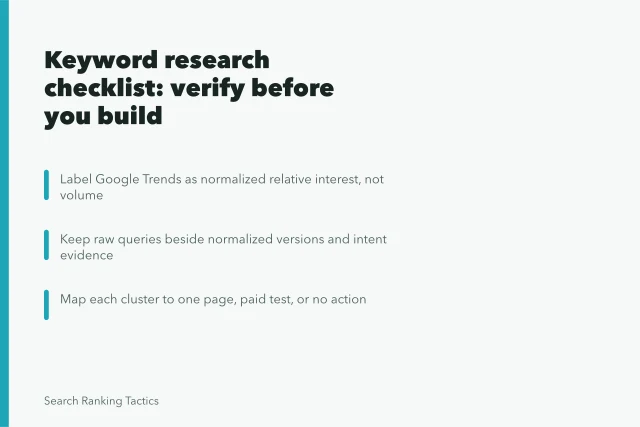
Set the baseline before the build and treat a flat result as information rather than a prompt to rewrite blind. The keyword research checklist covers the inputs worth confirming first.
Schedule the next review when the offer, the market or a source method changes. A calendar date alone will not catch that.