Rules
Part of Keyword research, minus the hype in 2027
Scoring a keyword research benchmark: coverage, clusters, and demand
Keyword research benchmarks in 2027 should measure source coverage, method completeness, cluster agreement, page-map use, demand ranges, outcomes, and uncertainty.
What to take away
- Benchmark research quality and decision usefulness, not one universal volume, difficulty score, keyword count, or traffic promise.
- Keep denominators and context visible so teams can distinguish coverage, completeness, reviewer agreement, mapping, and observed outcomes.
- Use ranges and uncertainty notes, then define the threshold and action that make each benchmark operational.
Keyword research benchmarks should measure research quality and decision usefulness, not promise one volume, difficulty, or ranking threshold. Markets, tools, products, and business economics differ. Build a baseline from the same sources and settings, then define ranges that trigger review, action, or stop decisions.
Source coverage
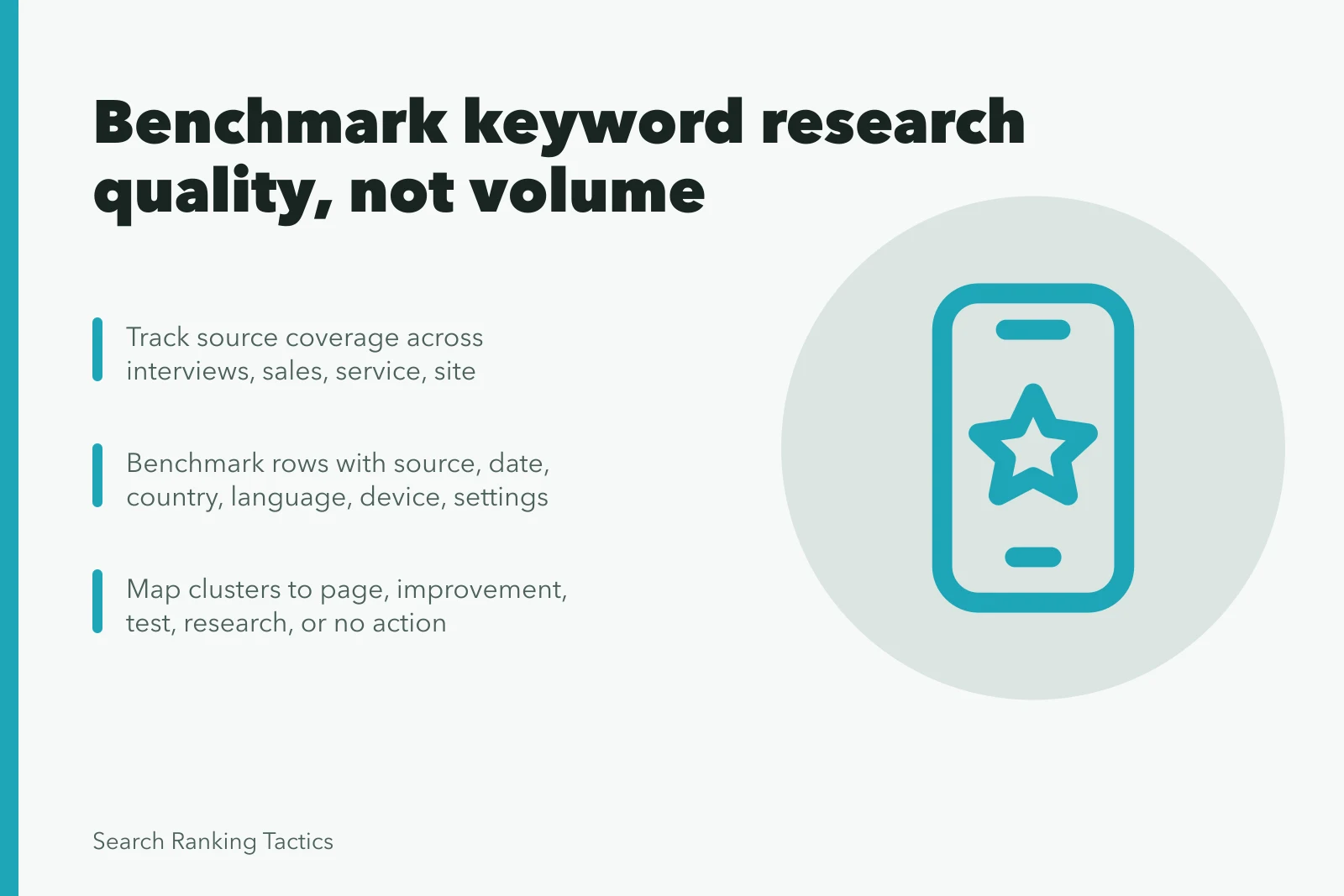
Track how many priority products, services, problems, audiences, locations, and customer stages have evidence from interviews, sales, service, site search, reviews, Search Console, and external tools. A long list from one platform is not diverse evidence. Record missing and unsuitable sources.
Source coverage evidence check
- Priority products, services, problems, audiences, locations, stages
- Interviews, sales, service, site search, reviews
- Search Console and external tools
- Record missing and unsuitable sources
- One platform list is not diverse evidence
Method completeness
Benchmark the share of rows with source, date, country, language, device or surface, database, unit, and settings. Google's quick comparison guide for Trends shows how a current period can be compared with a prior period and how geographic context can change interpretation. Record the comparison itself instead of copying an isolated value into a universal benchmark.
Reproducible row fields
- Source
- Date
- Country and language
- Device or surface
- Database
- Unit and settings
Task and cluster consistency
Sample important and ambiguous clusters. Ask independent reviewers whether the phrases represent one coherent task and destination. Record disagreement, false merges, false splits, and unclassified items. Automated clustering speed is useful only when the destination map remains comprehensible.
Page-map coverage
Measure the share of priority clusters mapped to an existing page, improvement, new destination, paid test, further research, or deliberate no action. Track competing URLs and unowned briefs. A keyword without a decision, destination, and owner is inventory, not strategy.
Demand ranges
Keep source-specific volume, trend, cost, competition, and proprietary difficulty fields separate. Google's Keyword Planner refinement guide describes refining ideas by category, location, language, network, dates, platform, and location segments. Use ranges and confidence notes, and benchmark stability across settings rather than forcing unlike measures into one average.
Observed performance
After release, compare intended groups with observed search diagnostics, landing behavior, qualified actions, contribution, and customer evidence. Segment by page role, market, device, maturity, and demand context. State attribution limits and concurrent changes before declaring that the research caused an outcome.
Use a benchmark card
- Measure, definition, source, settings, owner, baseline period, and refresh date.
- Applicable market, product, page group, and maturity window.
- Expected range, investigation threshold, harm guardrail, and confidence.
- Decision made when the benchmark is met, missed, or invalidated.
Decision table
| Benchmark | Denominator | Decision |
|---|---|---|
| Source coverage | Priority tasks or operating areas | Where is evidence missing? |
| Method completeness | Rows requiring reproducible fields | Can the analysis be audited? |
| Cluster agreement | Sampled important or ambiguous groups | Which groups need review? |
| Page-map coverage | Priority task groups | Build, improve, test, or decline? |
| Observed outcome | Released destinations or cohorts | Scale, revise, or stop? |
Make the comparison reproducible
The GAO evaluation design guide connects evaluation questions with evidence needs and design choices. Apply that discipline to keyword research benchmarks; federal evaluation guidance does not make a local marketing result causal or transferable.
The NIST experimental design selection guidance begins design choice with the objective and practical constraints. It supports separating keyword research benchmarks reporting from controlled effect estimates, not turning observation into causation.
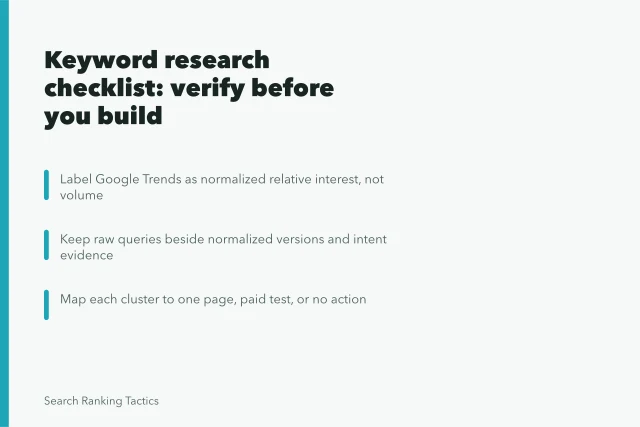
For keyword research benchmarks, keep the evidence record beside the decision so a reviewer can reproduce the reasoning without relying on memory. A keyword research checklist keeps that evidence record reproducible for the next reviewer.
Common questions
What is a good keyword research benchmark?
It is a reproducible measure with a visible denominator, context, source, period, uncertainty, owner, threshold, and decision.
Should a team benchmark keyword count?
Only as an inventory diagnostic. A larger list does not prove better task coverage, useful clustering, destination fit, execution, or business value.
How should uncertainty be shown?
Use ranges, confidence labels, known gaps, source limitations, reviewer disagreement, concurrent changes, and a threshold that would change the decision.