Operations
Part of On-page SEO: a focused business guide for 2027
Working through the on-page SEO checklist in order
On-page SEO checklist reviews in 2027 should verify purpose, evidence, titles, structure, links, media, markup, access, experience, measurement, owners, and risk.
What to take away
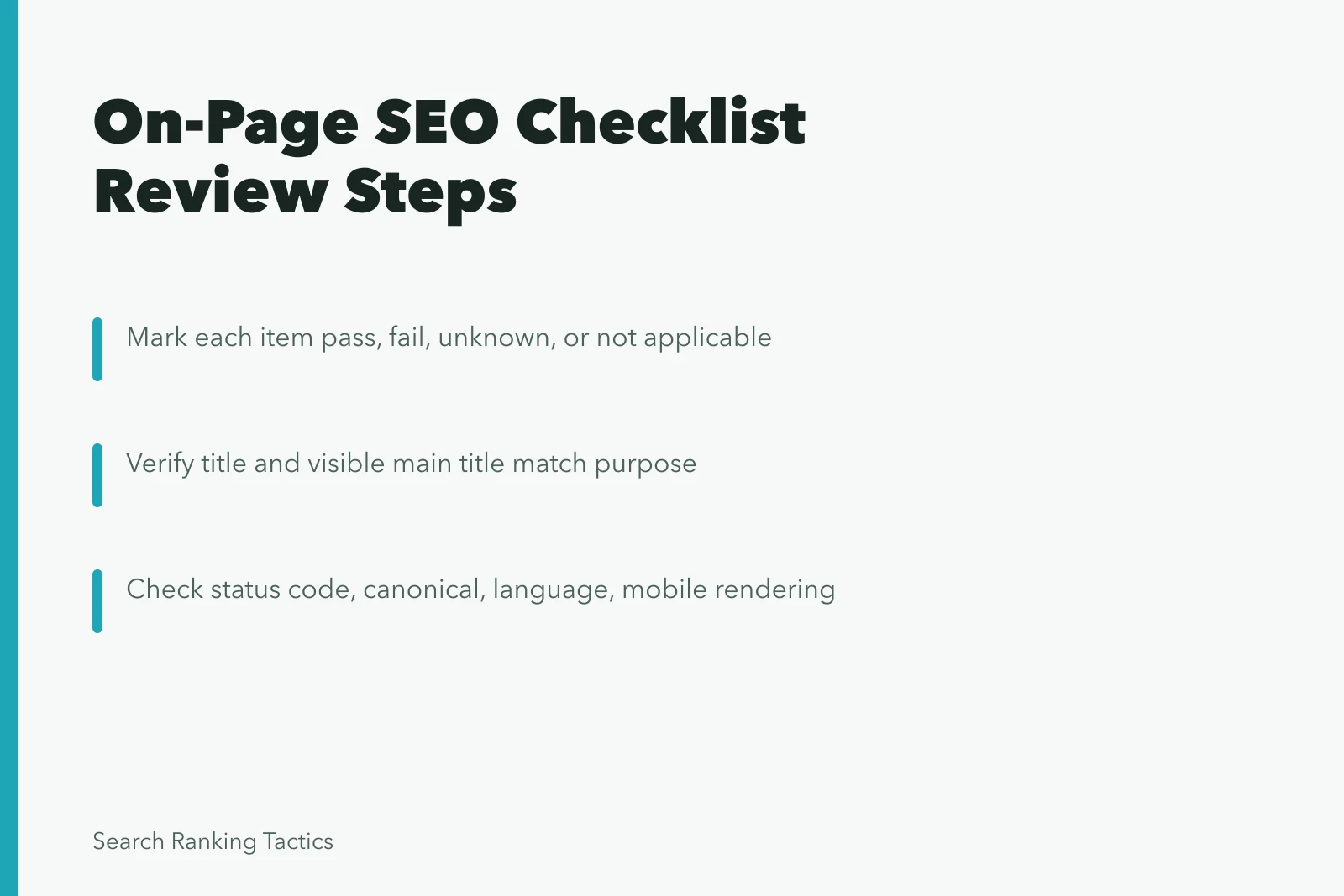
- Mark every item pass, fail, unknown, or not applicable, and attach the proof behind the verdict.
- Work in one orderpurpose and evidence, presentation and language, links and markup, access and index control, then release.
- Fix failures that change meaning, block a customer action, or alter indexability before touching wording.
- Keep evidence with the page record so a template change or staff handover has somewhere to start.
- A finished checklist documents a reviewed page. It does not promise a ranking or a rich result.
Score each item and attach evidence
Settle scoring before the item list. A verdict with no evidence cannot be audited later.
| Item state | Evidence to attach | Next action |
|---|---|---|
| Pass | Live URL, dated screenshot or export, owner name | Recheck at the agreed trigger |
| Fail | Cause, scope, customer impact, dependency | Fix, or accept the risk in writing |
| Unknown | What is missing: access, data, or judgment | Assign an owner and a deadline |
| Not applicable | Reason plus the approving owner | Revisit if scope changes |
| Released | Production check plus the outcome window | Confirm, revise, or reverse |
One failed canonical on a template matters more than twenty cosmetic wins. Score item by item, then rank the failures by impact. For context on what good looks like, on-page SEO benchmarks sets out realistic numbers by page type.
Work order from meaning to markup
- Purpose and evidence. Name the audience, market, task, and next action.
- Presentation and language. Check the title element, heading outline, and meta description.
- Links, media, and structured data. Check anchor text, image meaning, and supported markup.
- Access and index control. Check status code, robots directives, canonical, and language.
- Release. Record the baseline, the owner, and the recheck date.
Stop at the first unresolved item. A page written for the wrong reader does not improve with a tidier meta description.
Purpose and evidence: what passes
- The page names a real audience, market, task, destination type, and next action.
- The direct answer or decision frame appears early, with no generic preamble.
- Original facts, tested steps, dates, and limits are visible where a reader needs them.
- Company claims are labeled, and changing facts cite current primary sources.
Evidence here is concrete: a dated screenshot of the answer block and the URL of each source you checked.
Purpose and evidence checks
- Name audience, market, task, destination, next action
- Show direct answer early, no generic preamble
- Display facts, steps, examples, review, dates, methods
- Cite current primary sources for changing claims
- Label company claims as company claims
The recurring failures in this group, such as a page that never names its reader, are collected in on-page SEO mistakes.
Presentation and language checks
- Title element and visible main title describe the same purpose, with no repeated boilerplate.
- Headings form a logical outline and skip no levels.
- Customer language appears naturally, and units, dates, and places are unambiguous.
- The meta description is written for this page alone.
- The URL path is readable, concise, and reflects the page topic without unnecessary parameters.
- The page renders and works on mobile, with its main content and actions available.
The W3C heading tutorial is the reference for the outline check and warns against headings used only to make text look large.
Presentation and language checks
- Title element and visible title match purpose
- Headings form logical outline without skipped levels
- Lists or tables improve comprehension only
- Clarify ambiguous terms, models, places, versions, dates, units
- Meta description is page-specific
Pass evidence is a screenshot of the rendered heading outline beside the visual layout, plus the final description.
Links, media, and structured data
- Internal links use descriptive anchor text, lead to preferred canonical destinations, and make important pages reachable from relevant pages rather than only through filters.
- Informative images have useful alt text; decorative images do not add redundant text alternatives.
- The page adds distinct value and is not a near-duplicate of another page targeting the same need.
- Structured data uses the schema.org vocabulary, matches visible page content, and describes an eligible feature. Check Google Search Central’s current Search Gallery for Product, Article, Breadcrumb, and other documented features; FAQ rich results are limited to eligible authoritative government or health sites.
- Validate eligible Google rich results with the Rich Results Test and schema.org markup with the Schema Markup Validator. Neither test guarantees a search appearance.
Anchor text should describe the destination, and links belong on the preferred canonical URL rather than a filtered view.
Sort and filter options multiply near-duplicate URLs quickly. The faceted search entry explains how that navigation is built, which helps when you decide what to canonicalize.
Structured data is checked against the visible page. Prices, stock, and dates in markup must match what a reader sees, and the feature must be one search engines currently support.
on-page SEO examples shows how these choices play out across page types, which settles arguments faster than debating rules.
Verify index control and access
- The live page returns the intended HTTP status and does not unexpectedly redirect or return an error.
- robots.txt permits the intended crawler to fetch the page; page-level robots directives match the indexing and preview intent.
- The canonical in the page source identifies the preferred URL and agrees with the sitemap entry.
- Each hreflang reference points to the intended language or region version, and the set is consistent across those versions.
- Use Google Search Console URL Inspection to review Google’s crawl and indexing information. Use Bing Webmaster Tools’ robots.txt Tester to check Bing’s access against robots.txt.
- Check crawler and markup requirements in Google Search Central and Bing Webmaster Guidelines; follow current guidance rather than assuming a directive or feature is supported.
Record the intended directive, the live response, the crawler, and the URL scope. One pass item reads rel="canonical" href="https://example.com/widgets/blue/" in the source, matched by the same URL in the sitemap.
A robots meta tag sets page-level rules such as noindex, nosnippet, and preview limits. A crawler must fetch a page before those rules apply, so a blocked URL cannot act on them. The web crawler entry covers the fetch side of that limit.
Language and region signals belong in the same pass. In a bilingual market, each language version needs its own URL and a matching hreflang set.
Release checks
- Test the rendered page at a mobile viewport and confirm the content, links, and main action remain usable.
- Review page performance and Core Web Vitals with Lighthouse and PageSpeed Insights; record the result and any material issue to fix.
- Save the release baseline, named owner, evidence, and recheck trigger with the page record.
Example: pass and fail evidence for one page
| Item | Verdict | Evidence on file |
|---|---|---|
| Canonical | Fail | Source points to /widgets/, sitemap lists /widgets/blue/ |
| Heading outline | Pass | Rendered outline, one H1, no skipped levels |
| Meta description | Unknown | Template field empty in staging, no owner assigned |
The canonical failure outranks the description. It changes which URL search engines may treat as the page, so it goes to the template owner today.
To work the checklist in order, begin with purpose and evidence, then review presentation, links and markup, access and index control, and release. Capture evidence before assigning each verdict. In this example, the source canonical and sitemap entry disagree, so mark the canonical item Fail and send it to the template owner. Keep any item without evidence Unknown rather than assuming it passes. After the correction, recheck the affected page and update the evidence and verdict.
Rechecking after release
Recheck after template, product, policy, or market changes, and after any release that touched index controls.
Set the outcome window before release, and reopen the item when a result moves.
Questions that surface after release, such as who approves an exception, are handled in common on-page SEO questions with the business context attached.