Rules
Part of On-page SEO: a focused business guide for 2027
On-page SEO examples with practical lessons for teams
On-page SEO examples in 2027 offer nine hypothetical patterns for service, product, guide, local, comparison, video, event, support, and original research pages.
What to take away
- The nine patterns below are page designs illustrated with public pages from several companies. Examples include HubSpot, REI, Home Depot, Apple, and Wirecutter. Other examples are TED, SXSW, and Pew Research Center.
- Each pattern owes a distinct kind of material. Examples include operating limits, catalog truth, and tested steps. Other patterns need local proof, research methods, or support evidence.
- Adapt the mechanism to the actual page role, market, and customer. Then match the system, rights, and maintenance capacity before testing a bounded release.
Useful on-page SEO examples show how a page changes for a customer task. They are not templates to copy word for word. The nine patterns below connect page purpose, evidence, presentation, machine-readable data, and a measurable outcome. Each pattern names a real public page you can inspect.
Nine adaptable page patterns
Location page details
- Add genuine staff and service-area details
- Include hours, policies, photos
- Add local proof
- Avoid near-duplicate place-name pages
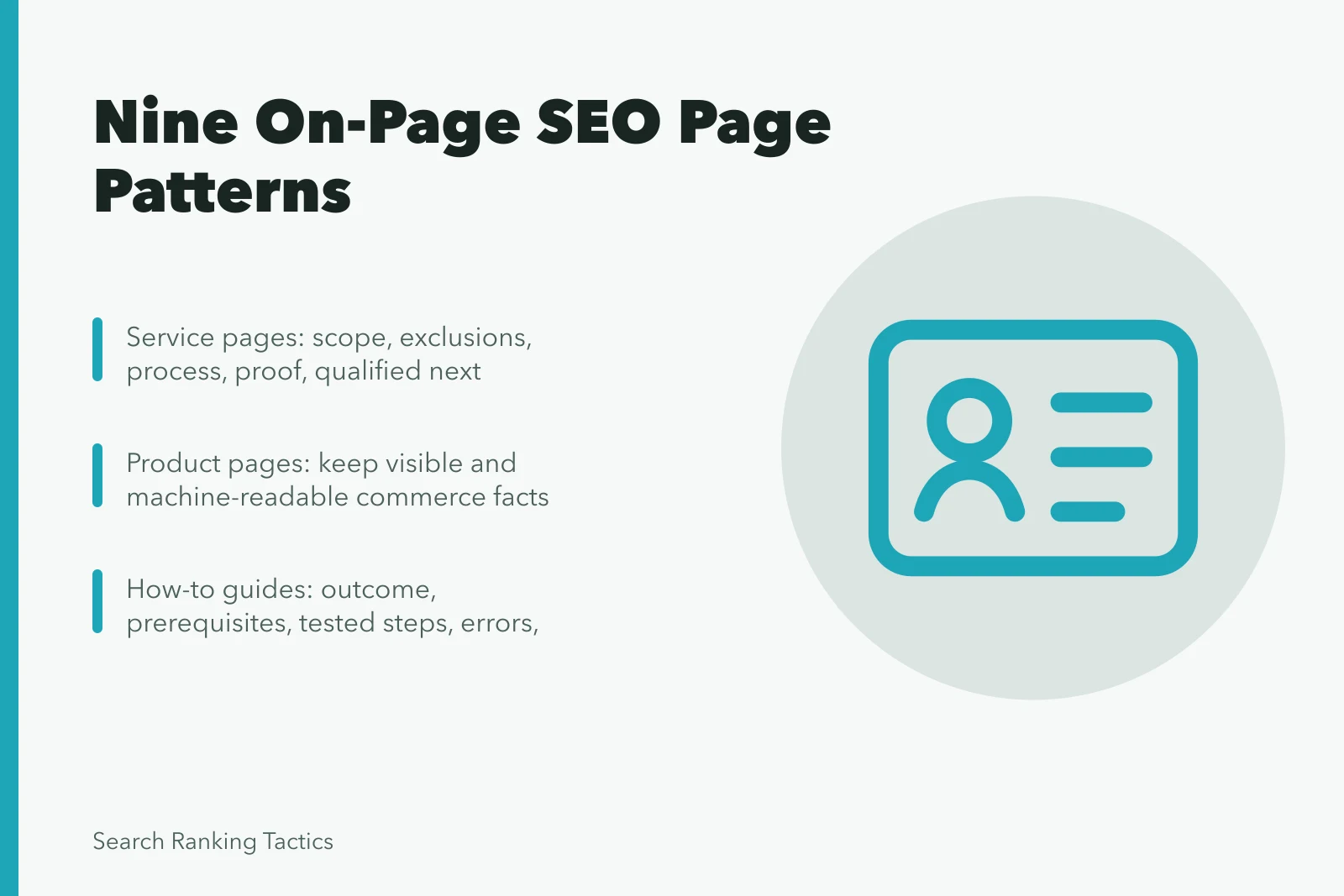
- Service page: state who the service fits. Cover scope, exclusions, and process. Add proof, locations, and pricing approach. Finish with a qualified next action. Measure suitable leads rather than raw sessions. HubSpot's Professional Services page lists onboarding, training, and technical consulting packages with deliverables. Name the minimum engagement and who answers the form. Inspect it at hubspot.com; search "Professional Services".
Product page consistency
- Keep model, price, availability consistent
- Match shipping, returns, variants
- Align images, reviews, Product data
- Do not mark up invisible information
What the examples share
Each page has one defensible job and a clear main title. It also needs original value, scannable structure, accurate media, and a next step. Use machine-readable information only when a supported type matches visible content. Treat validation as an eligibility check rather than a guarantee of presentation, traffic, or value.
Before adapting a pattern, inspect the market and the site's operations. Record the page and outcome baseline. Release to a manageable set, then check the rendered and indexed versions.
Decision table
| Page pattern | Distinct material owed | Outcome |
|---|---|---|
| Service: HubSpot Professional Services | Fit, scope, exclusions, process, and proof | Accepted inquiries |
| Product: REI Osprey Talon 22 | Current offer, variants, logistics, and rights | Qualified sales and returns |
| Guide: Home Depot ceiling fan install | Tested steps, decisions, errors, and safety | Completion and support reduction |
| Local: Apple Fifth Avenue | Staff, access, hours, policies, and local proof | Suitable local actions |
| Research: Pew Social Media Use 2025 | Question, sample, dates, method, and limits | Citation, use, and decisions |
Extra checks
The NIST Privacy Framework starting guide outlines a voluntary process for identifying and managing privacy risk. Use it to assign data and response owners for on-page SEO examples; it is not legal clearance. The W3C information and relationships explanation says visual structure and relationships should also be programmatically available.
Common questions
Are these on-page SEO examples proven campaigns?
No. They are public pages used as design references, not controlled tests or measured campaigns. The patterns show distinct information and measurement requirements.
Which on-page example should a team adapt?
Choose the pattern that matches the real customer task and page role. Then check the offer, evidence, market, and system access.
How should an example be tested?
Use a representative page group, retain a baseline, and compare search, customer, accessibility, and business evidence before scaling.