Rules
Part of On-page SEO: a focused business guide for 2027
On-page SEO trends: the shifts that matter
On-page SEO trends: AI Overviews, AI Mode, zero-click search, E-E-A-T, Core Web Vitals and INP, entity SEO, structured data, generative-search reporting.
What to take away
- A trend belongs in the page plan only when it changes a relevant customer, editorial, technical, measurement, or governance decision.
- Generated-answer features still require accessible indexed sources, while feature availability and reporting remain product-specific and changeable.
- Fund original evidence, task-complete media, accurate structured information, and auditable releases instead of chasing a new density or formatting formula.
On-page SEO trends for 2027 should be treated as planning signals, not predictions of guaranteed ranking changes. The shifts below extend current search-platform documentation and releases, including AI Overviews and AI Mode, zero-click search, E-E-A-T and helpful content, Core Web Vitals and INP, entity SEO, and structured data. These are the trends that already change page planning and can be tested with bounded risk. Only shifts that matter belong in the plan. Verify feature availability, country coverage, reporting definitions, and policy updates before changing a production site.
The on-page SEO trends to plan for in 2027
- AI Overviews and AI Mode.Google's generative search features summarize results and can link to indexed pages. Make pages easy to quote, cite, and verify with clear headings, direct answers, named sources, and accessible text.
- Zero-click search.More answers appear on the results page, so measurement must connect impressions and citations to later branded search, direct visits, and conversions.
- E-E-A-T and helpful content.Google's helpful content guidance and quality rater guidelines reward experience, expertise, authoritativeness, and trust. Show who made the page, how it was made, and why it is reliable.
- Core Web Vitals and INP.Interaction to Next Paint replaced First Input Delay as a Core Web Vital. Page experience still depends on loading, interactivity, and visual stability.
- Entity SEO and structured data.Search engines connect pages to entities. Use schema.org markup for Article, Product, Breadcrumb, Organization, LocalBusiness, Event, Video, and Review where it matches visible content.
- Generative engine optimization (GEO).Optimize for AI-generated answers by keeping facts current, citing primary sources, and making content easy to extract.
Generative search keeps core SEO foundations
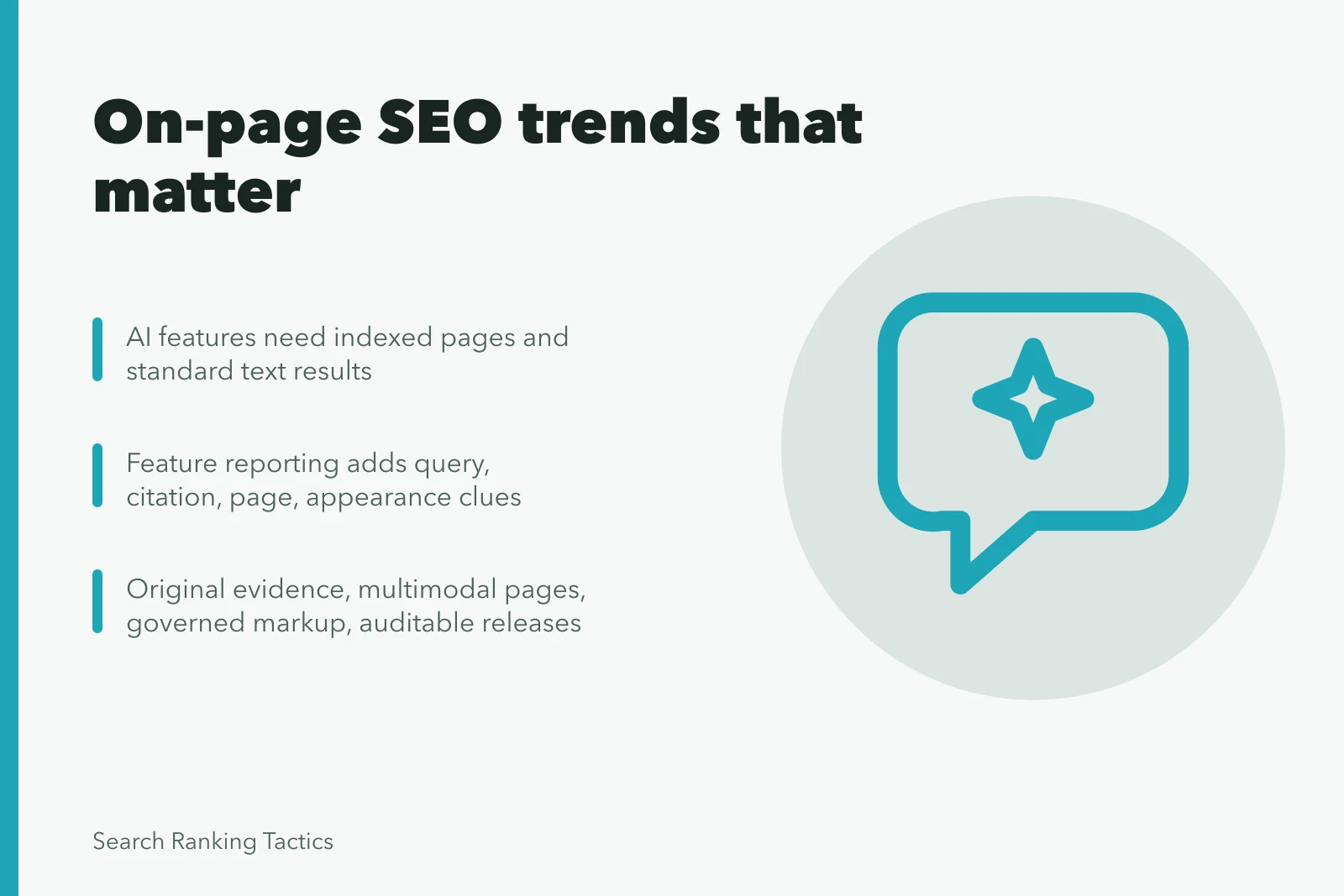
Google's AI Overviews and AI Mode guidance says pages must be indexed and eligible for a standard text result to appear as supporting links, and that established technical requirements and spam policies still apply. It also rejects special AI files or schema as a requirement. Maintain useful, accessible destinations and verify current feature and reporting scope.
Indexing eligibility flow
- Page must be indexed
- Eligible for standard text result
- Can appear as supporting link
- Technical requirements still apply
- Spam policies still apply
- No special AI files required
Feature-specific visibility becomes measurable
Feature-specific reporting can add query, citation, page, and appearance clues where a search product provides them. Define each term before use: a citation is a link to a source, an impression is a rendered appearance, and a click is a visit to your site. Preserve rollout, market, surface, sampling, definitions, dates, and later customer actions. A citation or impression does not automatically prove authority, ranking, visit quality, or business value.
Google Search Console has announced testing of generative AI performance views, and Bing Webmaster Tools documents a Bing AI Performance preview. Both are early reporting surfaces, so treat their metrics as directional until the products define coverage, sampling, and attribution.
Feature reporting records
- Query
- Citation
- Page
- Appearance clues
- Rollout and market
- Surface and sampling
- Definitions and dates
Commodity summaries lose editorial value
As basic synthesis becomes easier, pages need evidence that belongs to the organization: tested methods, original data, direct experience, expert judgment, product truth, working tools, useful media, and accountable corrections. Protect source records, consent, rights, methods, raw data, and update ownership.
Pages become more multimodal and task-complete
Text, images, video, product attributes, local details, and interactive tools can serve different discovery surfaces and customer needs. Add only media that improves the task, then provide suitable alternatives, rights records, context, stable delivery, performance controls, and a maintained source of truth.
Structured data requires tighter governance
Google's supported structured-data gallery lists the current feature guides and states that actual appearances can differ. Use it as a dated eligibility index for types such as Article, Product, Breadcrumb, Organization, LocalBusiness, Event, Video, and Review, then follow each type's required and recommended properties, synchronize changing facts, test the implementation, monitor errors, and remove unsupported or misleading markup.
On-page work becomes an evidence system
Teams need release records connecting page purpose, sources, reviewer, template, canonical intent, structured information, media, acceptance tests, guardrails, and outcomes. Automation can check syntax and drift; people must still judge truth, relevance, accessibility, customer effect, and contradiction.
- Acceptance testspass and fail conditions for each changed template or feed.
- Rollbacktrigger, owner, and time limit.
- Release logdate, scope, owner, and decision.
Illustrative example: a retailer tests availability markup on 200 product pages. The pass mark is 90 percent of sampled URLs validated within 14 days. Roll back within 24 hours if errors exceed 5 percent. These figures are illustrative.
Operational shifts to plan for
- Entity facts and freshnesskeep facts about products, people, locations, prices, and policies current, and assign owners and update triggers.
- Consolidationmap customer tasks, ownership, and retirement paths.
- Measurementconnect visibility and citations to customer actions and business value.
- Accessibilityreadable structure, descriptive links and media, keyboard use, stable rendering, and clear forms reduce technical ambiguity.
- Governancedomains, platforms, navigation, templates, and feeds can affect thousands of destinations, so join planning early, keep account ownership, and write acceptance tests before release.
Prepare without chasing speculation
Inventory page types, original evidence, unsupported markup, inaccessible media, duplicate destinations, stale facts, and measurement gaps. Create controlled refresh and testing cycles. Follow Google Search Central change logs and product documentation, while labeling vendor theories and anecdotal tactics as unverified until direct evidence supports them.
Decision table
| Trend signal | Bounded response | Do not infer |
|---|---|---|
| AI search features | Maintain useful indexed sources and measure later actions | A special schema guarantees inclusion |
| Feature reporting | Keep definitions, scope, and dates | Citation equals authority or revenue |
| Original evidence | Fund one maintained source asset | Novelty alone creates demand |
| Multimodal pages | Improve one task-complete media workflow | More media is always better |
| Markup governance | Inventory support, truth, owners, and errors | Valid syntax proves the claim |
Maintain a dated watchlist
Watch AI Overviews and AI Mode expansions, Search Console generative AI reporting, Bing AI Performance preview, Core Web Vitals thresholds, and new or deprecated structured-data types. Label vendor theories as unverified until official documentation or your own tests support them.
For each watchlist item, record the official source, the page types affected, the metric or eligibility rule, the owner, and the review date. Retire items that do not change a page or customer decision.
Common questions
Which on-page SEO trend matters most in 2027?
The material trend is the one that changes a real page or customer decision and can be tested with credible evidence and bounded risk.
Does AI search require special structured data?
Google's current guidance says no special AI schema or file is required. Standard eligibility, useful content, and accurate supported markup remain relevant.
How should a team respond to on-page trends?
Choose only relevant signals, define the mechanism and stop rule, run a reversible test, preserve the release record, and review customer and business evidence.